The Full Milonga That Was Empty
October 18, 2026
tango#tango#scene-maturity#community#network-theory#ecology-of-tango
Part 1 of The Ecology of Tango: an observation about milongas and events from a dancer’s and an organizer’s perspective --- and a hypothesis about how scenes coordinate.
The empty room that was full
Take a region with seventy active dancers. Tonight’s milonga draws thirty-five --- half the scene showed up, and the organizer is pleased: “a healthy evening”.
But you strongly enjoy dancing with four of those seventy. None of the four came. From where you stand, “the room was empty”.
Both describe the same evening correctly. The organizer counted dancers; you counted relationships, and felt their absence. That gap — between how many people are in the room and how many of them you actually want to dance with — is something we tend to overlook when talking about healthy tango scenes.
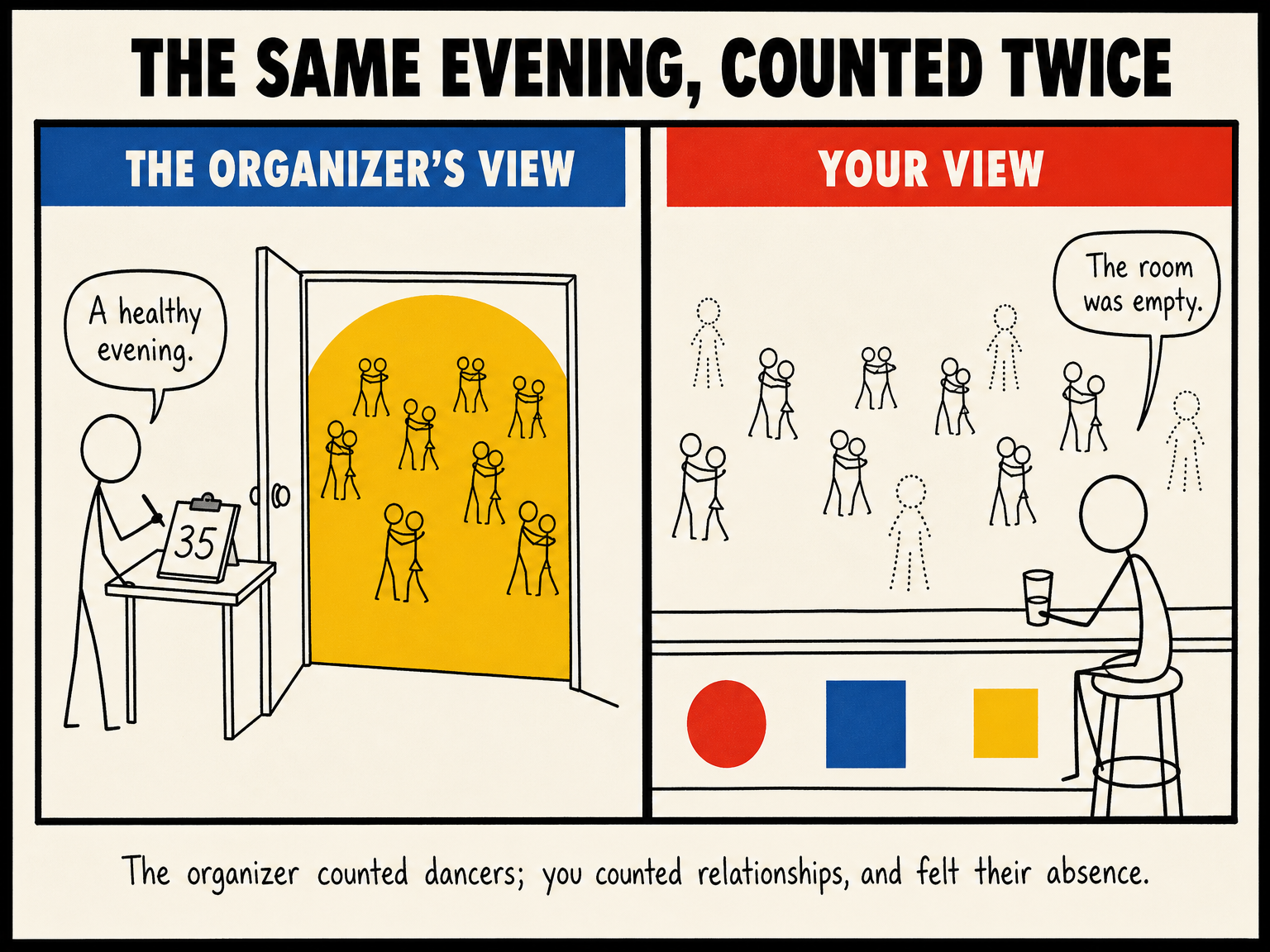
It’s a strange way to measure the health of a dance community: count the people, ignore the dances they could actually have --- or even just the conversation between them.
And it is why the most useful sentence in a scene is not a complaint but a question.
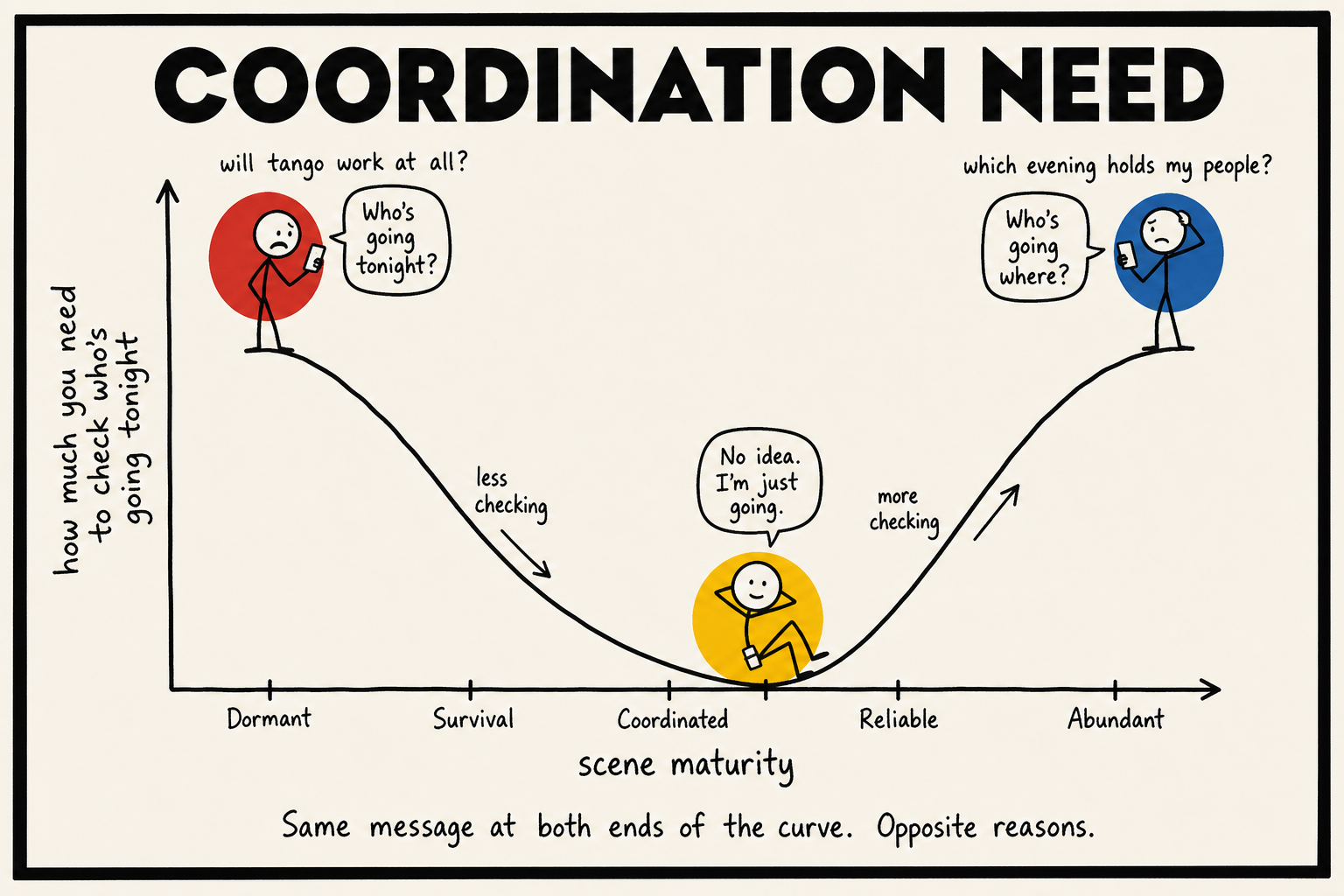
In the scenes where your evening depends on exactly who shows up, you do not ask “Who’s going tonight?” because tango might not happen. You ask because your tango might not happen.
“Who’s going tonight?” — The same message, four meanings
The questions we ask before dancing:
-
A scene held together by a thread. Someone posts the question in the group chat and because some go, the others also come.
-
A settled scene. People just go; the evening will work whether or not anyone checked.
-
A big city. The question changes shape: “Who’s going where?” Four milongas on Saturday, and the people you want are spread across all of them.
Could the coordination a dancer needs, and the reason for it, say something about a scene’s maturity?
But the same room can feel entirely different to two dancers: effortless for someone socially well connected, thin for a newcomer who knows two people.
The model in my head tries to read the scene’s distribution of reliable evenings across all of its dancers --- not what any one of us happened to find last Saturday. A single dancer’s experience is a data point about where they stand in the network, never the scene’s level.
Different levels of tango scene configurations
The following table summarizes the different levels of tango scene configurations, measured by how much a dancer needs to know or arrange in advance to reasonably expect a satisfying evening. Milongas always need coordination to exist --- organizers, schools, networks all do real work --- but the less a dancer personally has to arrange, the more the scene’s infrastructure and network are doing that work for them. That is the quiet trade the levels measure: individual effort on one side, collective reliability on the other.
How much does a dancer need to know or arrange in advance to have a reasonable expectation of a satisfying evening?
| Level | Scene configuration | Dancers say | The coordination problem |
|---|---|---|---|
| 0 | Dormant | “Is there tango here?” | No recurring system |
| 1 | Survival | “We have to go.” | Bodies to keep tango alive |
| 2 | Coordinated | “Who’s going tonight?” | Enough of the right partners |
| 3 | Reliable | “No idea. I’m just going.” | Little advance checking needed for many dancers |
| 4 | Abundant | “Which milonga are you going to?” | Choice between viable events |
| 5A | Resilient | “Whichever one I pick, it will probably work.” | Redundancy at the event level |
| 5B | Fragmented | “Where did everybody go?” | Too many rooms for one network |
Three things these levels are not.
- not a ranking: maturity here does not mean better, larger, more professional, or more culturally legitimate --- it means how much coordination is required for a satisfying evening to happen. A small town can sit at 3 while a big city scrambles at 2.
- not a staircase a scene must climb in order; it is a lens for reading how an evening is put together.
- not read off any single dancer’s evening: the level describes the scene’s whole network, how it hands out reliable evenings across everyone in it --- the same Saturday can be a 3 for one dancer and a 2 for another, and neither answer is the scene’s score.
The underlying claim is modest: a community becomes reliable when many different dancers can arrive without prearranging their evening and still expect worthwhile dancing. Most of what follows unpacks that sentence.
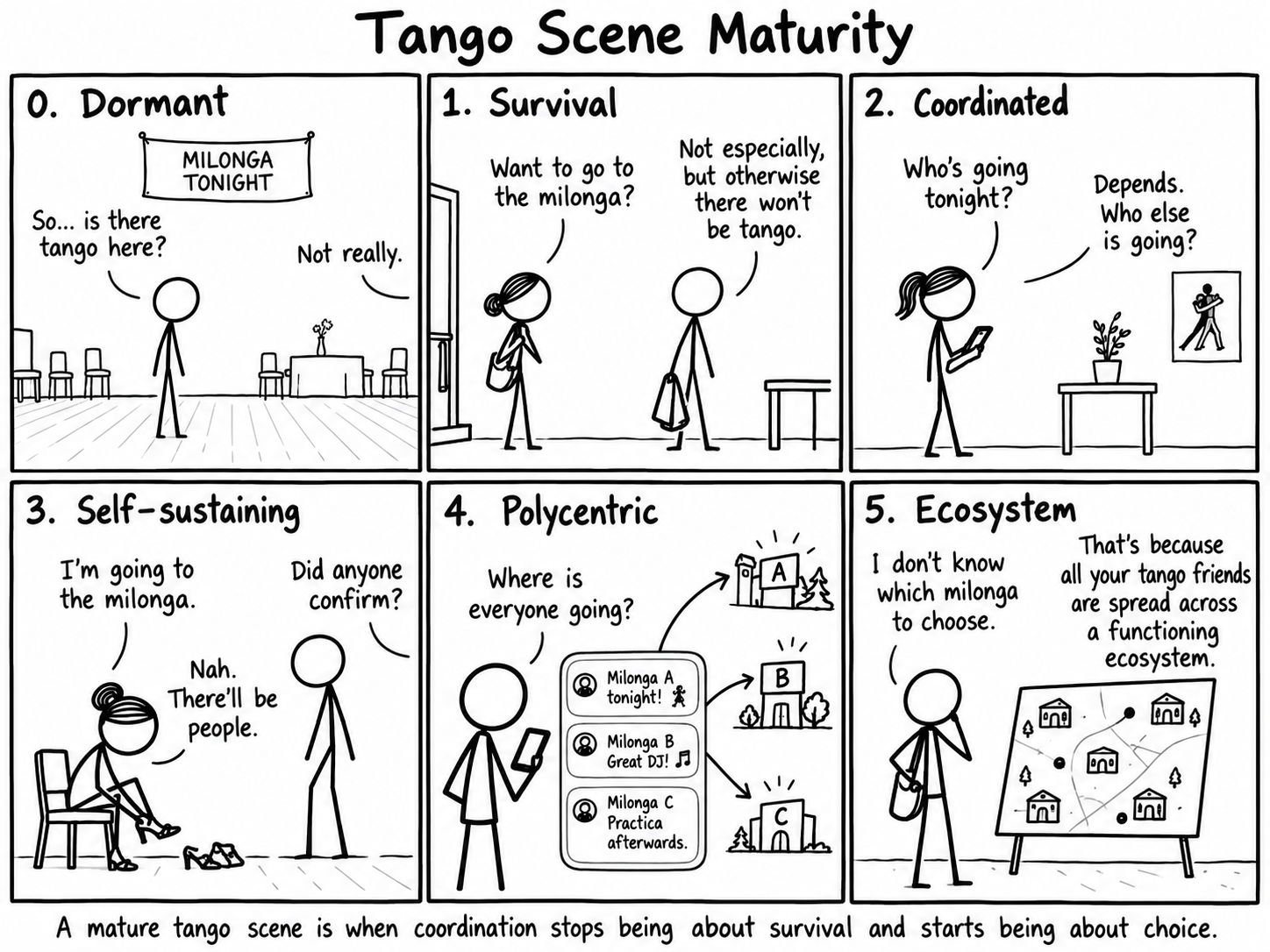
A simplified sketch: the comic shows six numbered states and stops; this post’s model keeps five and splits the top. Its panel labels are its own.
Level 0 - “No milonga tonight”
People who dance tango here and there, but no reliable local system. Dancers are not a scene: thirty people who know tango do not automatically produce a scene, unless they actually organize and coordinate themselves.1
Level 1 - “We have to go”
“We have to go.” Or: “I wasn’t really planning to, but otherwise there will be six of us.” Attending has two functions at once: enjoying tango and keeping it viable. Supporting the milonga is literal: your presence is part of the evening’s infrastructure. Remove one organizer or a few regular couples, and it stops.
Level 2 - “I have to check who’s going”
The anxious middle. The scene exists, the calendar exists, the milonga will not collapse if you stay home --- but your evening still depends heavily on a small set of people. Enough dancers that some tango will happen; whether it is worthwhile for you, specifically, is another question.
Headcount is not enough.
The empty-room contradiction above needs a name. I use a shorthand: effective partner density. Not how many people are present, but how many realistic, mutually desirable dancing relationships are available that night. Attendance, taste compatibility, time availability --- a way of thinking, not a measurement model.2
And compatibility is not limited to dancers we already know --- a healthy scene also makes it possible to discover new ones.
Why would seventy dancers not be 35 interchangeable partners? Homophily research has an answer: ties form between similar people, and networks settle into niches --- of style, of age, of tribe.3 A room is not a pool of partners; it is overlapping groups of people who might actually want each other’s dancing. Translated to tango: not everyone in the room is a potential partner for everyone else.
The scarce resource in a tango scene may not be just dancers.
It may be mutually compatible dancers being in the same room at the same time.
Level 3 - “I’m just going and it will be nice!”
In some scenes the question stops being asked: people still care who they dance with, they just trust the milonga. Peter would be nice, but if Peter stays home, Anna, Maria, Luca, or somebody new will be there.
Two things may make that trust more reliable than headcount alone. The first is critical mass --- maybe a better indicator of scene health than population size: not how many people could dance tonight, but whether enough useful relationships become possible when the music starts. Repeated collective activity runs on tie density, not group size.4 The second is what holds such a milonga together between its cliques: loose ties crossing otherwise separate clusters --- the dancers who move between groups and carry the energy with them.5
What the research sees from outside
Banfi’s autoethnography captures level 2 from the inside: arriving at a milonga and wondering, before the dancing starts, whether there will be good dances, hoping to see familiar faces.6
And the strongest scenes feel like more than calendars for another reason Banfi documents: newcomers become regulars by participating until the scene’s codes are theirs --- or they bounce off.7 That is when a milonga becomes a third place, where recognition and shared memory accumulate. Though repetition alone does not create that.
The twist: abundance forks
Level 4 - “Abundant choice”
Level 4 is when several good milongas run on the same night. Not a failure: choice means the ecosystem grew large enough for different venues, organizers, DJs. But abundance is a branching point.
Level 5A - “Resilient abundance”
Each subpopulation still holds enough compatible partners; whichever door you pick, the evening will probably work.
Level 5B - “Fragmented abundance”
Total supply has grown while effective partner density per event has fallen. Three milongas tonight, and somehow nobody I want is at the one I chose. Excellent. We have successfully created three empty rooms. “Empty” is hyperbole, and 5B is not level 6, just a failure branch off abundance.
Conclusion
At first, “Who’s going tonight?” sounds like a simple question about attendance. Sometimes it’s about keeping a milonga alive. Sometimes it’s about finding a satisfying dance. And sometimes, in a city full of milongas, it’s about figuring out where your people have gone.
But perhaps the most revealing thing is not how often the question gets asked. It’s who still needs to ask it.
Footnotes
Footnotes
-
Silver, Clark & Navarro, “Scenes: Social Context in an Age of Contingency”, Social Forces 88(5), 2010 --- DOI. Sociology builds “scene” from places, activities and shared sensibilities, not headcount. Not about tango; scaffolding, not evidence. ↩
-
Federica Banfi, The Movement of Argentine Tango: An Ethnography of Improvisation and Transnationalism, PhD thesis, Queen’s University Belfast, 2021 --- open access. Multi-sited ethnography of Buenos Aires and European milongas; the closest thing to direct evidence this post has. The point I lean on: satisfactory dances depend on more than objective skill --- taste, style and musicality can keep two capable dancers from connecting at all. ↩
-
McPherson, Smith-Lovin & Cook, “Birds of a Feather: Homophily in Social Networks”, Annual Review of Sociology 27, 2001 --- DOI. Which dimensions dominate tango partner selection --- ability, style, age, role, tribe, taste --- is an open question and my hypothesis. ↩
-
Marwell, Oliver & Prahl, “Social Networks and Collective Action: A Theory of the Critical Mass. III”, American Journal of Sociology 94(3), 1988 --- DOI. Network theory about collective goods, not dancing; the transfer to tango is my analogy. ↩
-
Granovetter, “The Strength of Weak Ties”, American Journal of Sociology 78(6), 1973 --- DOI. Foundational network theory, used here for one idea only: bridges between clusters. ↩
-
Same thesis. Her arrival passage --- will there be good dances? any dances? familiar faces? --- is level 2 written down from the inside, before the music starts. ↩
-
Banfi reads tango learning through Lave & Wenger’s Situated Learning: Legitimate Peripheral Participation (1991) and Stebbins’s serious-leisure framework (2007). Learning theory, applied to tango by Banfi herself. ↩