Are we losing critical tango infrastructure?
August 29, 2026· updated September 27, 2026
Some thoughts, because this touches a topic that for some in the community seems to be a taboo: money.
At least in Germany, more and more of our tango locations are under commercial pressure. Leases end. Rent goes up. And running a studio becomes not profitable enough to justify the time and effort it takes to maintain it.
What is left, then, is a question: are we losing critical tango infrastructure — the studios and venues that are the home bases of our local scenes?
Money is not a dirty word
Let me get the concession out of the way first, because it matters: almost nobody in tango organizes to get rich. I have been joking often enough that the only people who make money on marathons are the landlords and the caterer (and I know a bit about the economics of the events we organized — marathons with 200–230 participants in Germany, venue costs somewhere between 300 and 1500 per day, from my memory, pre-pandemic — YMMV).
But that is exactly the trap. Because nobody does it for the money, we treat the money as something we don’t talk about. And what we don’t talk about, we don’t plan for. Then one day the lease ends, or the energy bill doubles, or the person who ran the practica for ten years burns out — and we act surprised.
Tango is local, not digital.
It happens in rooms, in the here and now (a line from the tango.connects conference, quoted there — I wrote about it earlier this year). Without rooms, we don’t have tango anymore. We have a WhatsApp group with memories.
What a studio actually provides
It is worth being concrete about what we lose when a venue closes, because “infrastructure” sounds abstract.
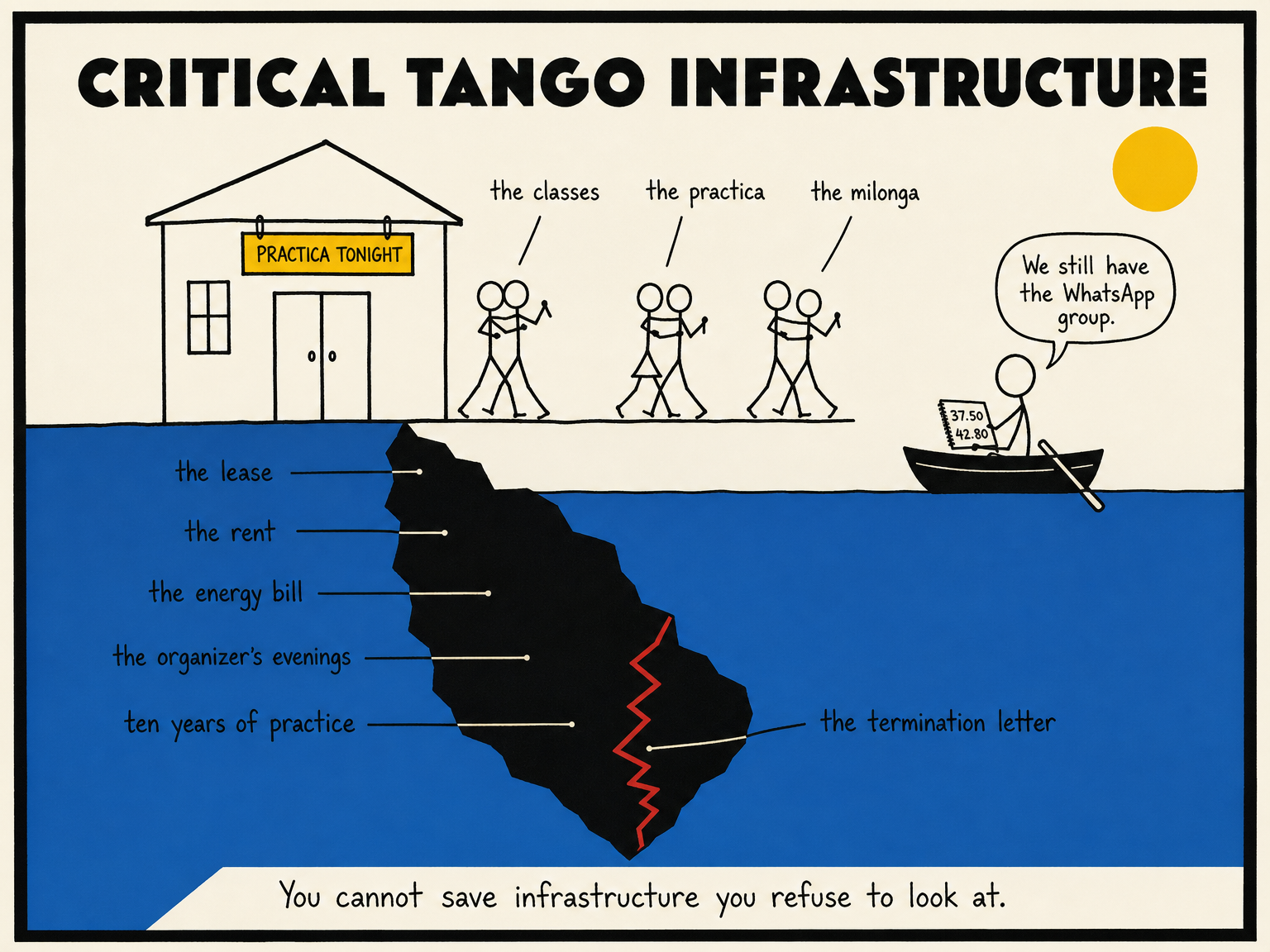
A studio is not just a floor. Depending on who you are in the scene, it does different jobs:
- Beginners get a place where they are allowed to be bad. A practica in a fixed, familiar room lowers the barrier to show up again next week — which is the whole game for the first year.
- Organizers get a base with predictable logistics: floor, sound, mirrors or no mirrors, neighbors who tolerate tango music at 23:00. Every milonga you attend started with somebody solving the room problem first.
- Teachers and DJs get the stage their work depends on. No local teachers without local classes; no local classes without rooms that are affordable enough to run them at local prices.
- The scene as a whole gets an anchor. The home milonga is where people meet outside of events, where visitors get integrated, where the community exists between weekends.
That last point is the one we underestimate most. Events are highlights; the studio is the heartbeat. A scene that only meets at events is a guest list, not a community.
Why the pressure is structural — not a moral failure
The venues are not closing because organizers are lazy or dancers are stingy (well — sometimes, but that is not the pattern I see). The pressure is structural: city-center real estate gets repositioned, energy costs rose sharply after 2022, not to mention the strain of the pandemic on culture and tango, in general. Landlords can often rent to someone else for more, and the classic organizer model — one person volunteering their evenings, forever — quietly eats the people it depends on
This also connects to the discussions we have been having about digital infrastructure. We spent years building our online community on rented land, and the landlord can change the terms (that argument lives here). The digital version at least has a fix we are building, piece by piece, out of boring, unglamorous parts (written up here). The physical version is older and more brutal: the landlord doesn’t even need an algorithm. Just a termination letter.
Three ways scenes try to hold on to rooms
I don’t have the one answer — I am curious about yours. But it helps me to see the models side by side:
| Model | What it solves | What it breaks |
|---|---|---|
| Pure commercial (organizer rents by the hour, covers it from entrance fees) | Flexible, no long-term commitment, low barrier to start | No resilience — every rent increase or empty evening hits directly; the organizer carries it alone |
| Verein / cooperative (the community owns or co-runs the space) | Shared risk, shared work, long-term leases become possible | Needs people who do administration (surprise: that is also work), slower decisions, foundation energy |
| Something in between (multi-use space, shared with other dance or arts scenes, bar/café subsidizing the floor) | Fixed costs get distributed over more hours and more users | More coordination, compromises about floor time and music, and it still needs somebody who treats it as a project |
That third row is where I would look first. It is also exactly the direction the community is already discussing — proTango e.V. ran a Themen Tisch on 26 September 2026, titled “Studio, Verein oder etwas dazwischen? Organisationsformen für eine tragfähige Tango-Arbeit”. The question is in the air.
facebook.comTango Themen Tisch #3 — Studio, Verein oder etwas dazwischen?Organisationsformen für eine tragfähige Tango-Arbeit. Online per Zoom, Samstag 26. September 2026, 11:00–12:30, kostenlos. Gäste: Michael Freundt (Dachverband Tanz), Ingo & Juliane (Haus-der-Sinne e.V. Berlin).protango.deproTango e.V. – Bundesweite Interessenvertretung der Tango ProfessionalsWhat would be a first starting point?
Honest trade-offs before the invitation: none of these models removes the core problem that tango’s costs are real and its willingness to pay is emotional, not economic. A Verein does not make rent cheaper; it only spreads it. And a shared space means sharing it.
Still, a first step that costs almost nothing: make the numbers visible. Whatever milonga or practica you are involved in — write down what the room, the DJ, the sound actually cost per evening, and what the entrance fees bring in. Not to publish it necessarily (though transparency rarely bites as hard as people fear). To know.
You cannot save infrastructure you refuse to look at.
I am curious about the actual stories: which studios or milongas in your cities disappeared, which survived — and how. If you have stories, links or ideas, please share them, and I will collect them here.
Abrazos, Daniel