Scene from a marathon: the hierarchy we co-create
April 8, 2019· updated September 27, 2026
I wrote this down after a marathon a few years back. Not triggered by any recent event — it is an observation I have made multiple times over the years, and it has influenced our own event organization, and also our selection of where to go, and where not. When I started moving old notes onto this blog, it felt worth re-publishing, because the behavior it describes has not gone away.
The scene
Here is the paradox I keep seeing:
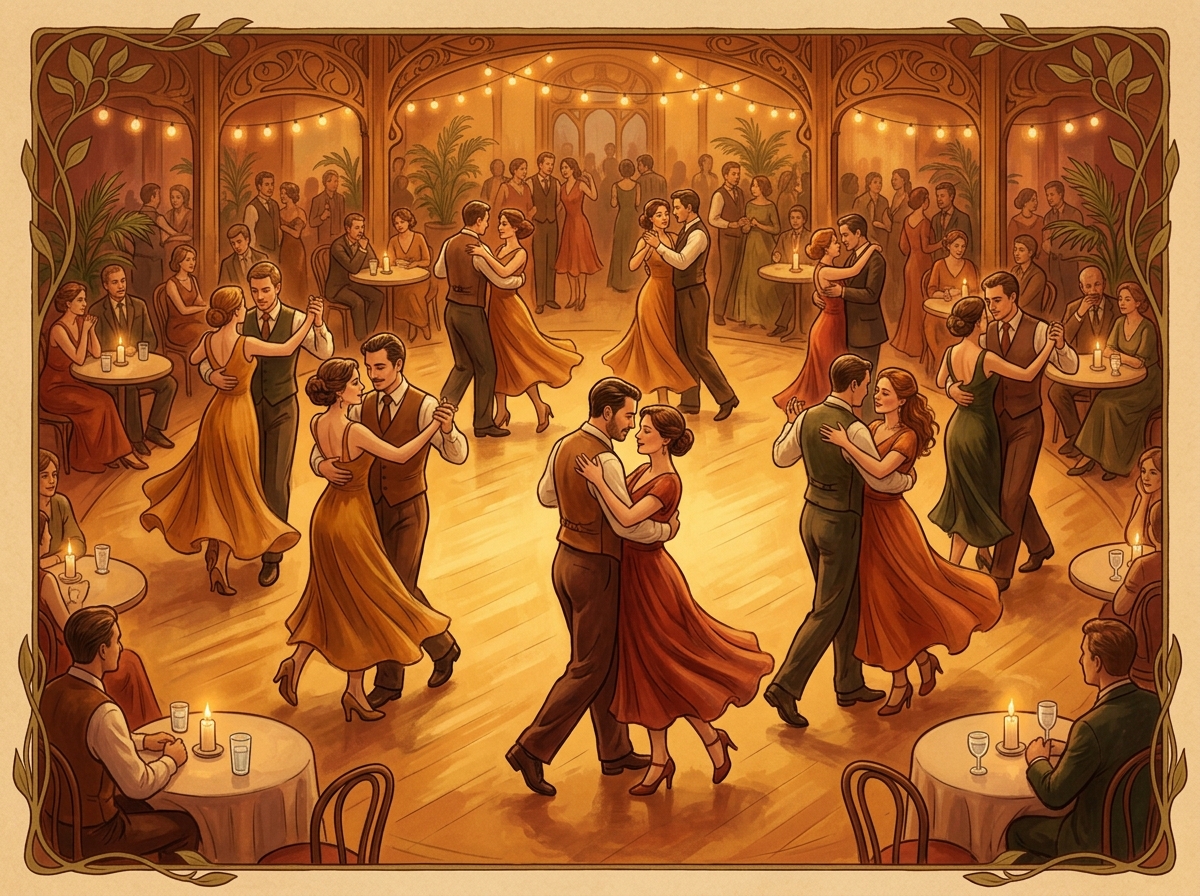
You could dance with anyone in the room, and it would be much better than any tanda in your home milonga. Yet you still don’t dance with just anyone — because there is a chance of getting a tanda that is so spectacular… And any tanda on the way to that spectacular tanda suddenly feels not good enough.
But everyone plays that same game, so it seems. In the end we co-create a hierarchy in the room that leads to some people dancing a lot, and others not dancing at all. And even worse: that spectacular tanda with that new partner never happens — because everyone is trying to play it safe to increase the chances of “dancing up the level/hipness hierarchy”.
What a strange world.
How the game works
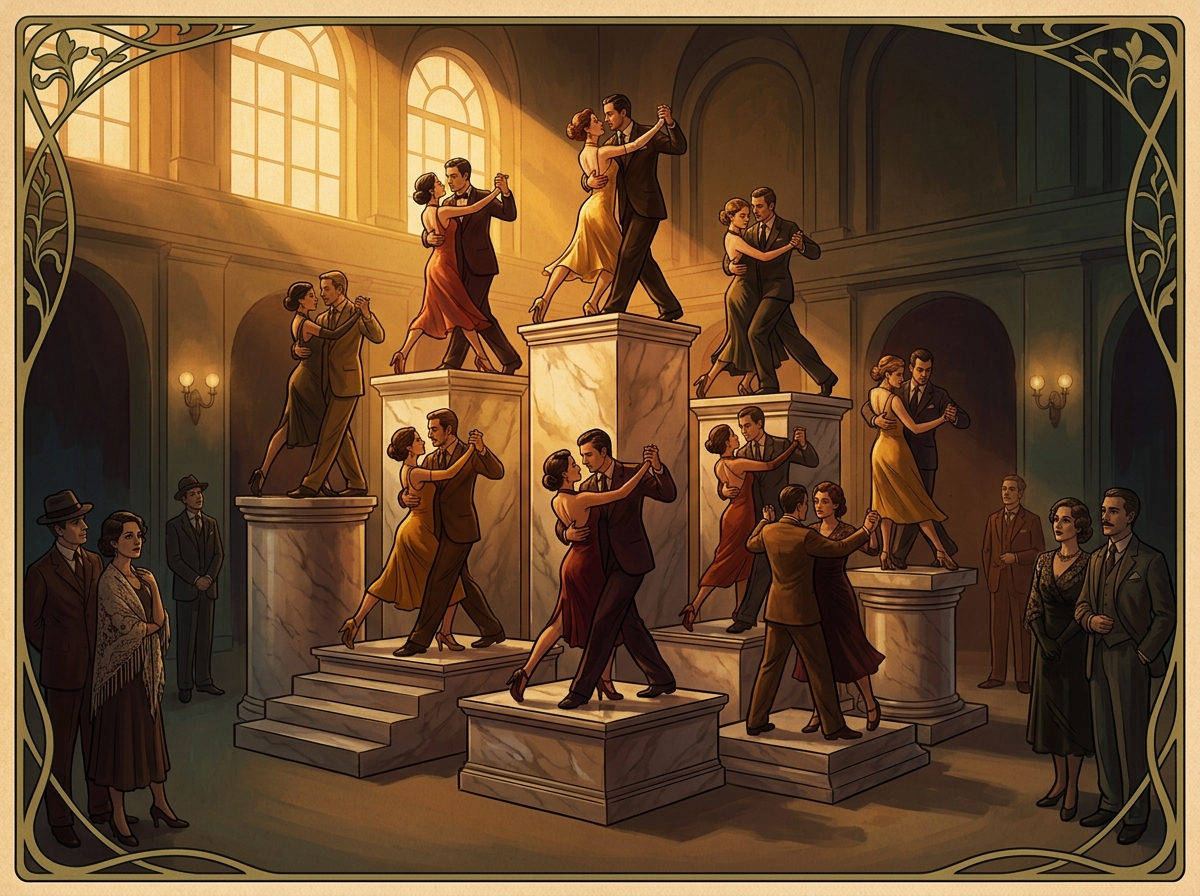
Nobody designs this hierarchy. It emerges, tanda by tanda, from thousands of small miradas and small refusals. The mechanics are simple enough:
- Everyone ranks the room, at least mentally — who would be a spectacular tanda, who would be “just good”.
- Each of us aims slightly above where we place ourselves — that is where the spectacular tanda might be.
- To protect those chances, we play it safe: we spend our acceptance on the partners we are sure about, and we hedge everywhere else.
- Multiply that by the whole room: the people at the top of everyone’s mental ranking dance a lot, the people below the average dance less, and some — often perfectly good dancers — barely dance at all.
And here is the twist that makes it tragic rather than just unfair: the spectacular tanda that everyone is optimizing for rarely happens. The safe plays eat the evening. The hierarchy we built to reach more connection is exactly what prevents it.
Not just a marathon thing — but marathon-shaped
Is this only about marathons? No. The same behaviors show up in other event formats, just with a different focus on one or another experience. But there is a reason I saw it clearest at a marathon.
- Milonga: a mixed local room, wide spread of levels and intentions — the hierarchy exists, but it is diluted by familiarity and by the social fabric around the dance.
- Festival: many strangers, plus the pull of the famous names on stage — the hierarchy shifts towards teachers and stars, as anyone who has queued for the workshop teachers’ table knows.
- Marathon: a curated, often closed room. The whole premise of the format is a relatively high and homogeneous level — that is the base of the closed event.
And that is what makes it so sad to watch there: in a room that was explicitly built to minimize the “risk of pain” — where almost any tanda should be a good tanda — we still manage to reconstruct the very hierarchy the format was supposed to make irrelevant. We bring the scarcity mindset with us, and re-install it in a place designed to have none.
What this has to do with the “one tanda” discussion
I keep coming back to this scene when I read discussions about how event culture is changing — for example the shift towards dancing one tanda with a partner instead of many, which I explored in Exploring the Shift to One Tanda in Tango Dancing. Much of what that trend is reacting to, I suspect, is exactly this co-created hierarchy: if tandas are scarce and hierarchical, people optimize partners. If tandas are abundant and playful, people optimize the evening.
It also connects to the debate about what separates a marathon from an encuentro and everything in between — see The Great Debate: Encuentro vs. Marathon. The formats differ in what they promise; the hierarchy problem shows up wherever dancers believe the room is ranked.
And when someone comes home from an event and asks “why don’t they dance with me?”, the honest answer is rarely about their dancing. It is about the game the whole room is playing — which is close to what I tried to work out in Tango Snobbery?.
So what do we do with this?
I don’t have a recipe, and I am suspicious of anyone who claims to have one. The hierarchy is not enforced by organizers; it is co-created by all of us, one mirada at a time. Which also means it can be dismantled the same way — but that part is much harder to write about than to diagnose.
Some directions that seem worth trying, in no particular order:
- Organizers: think about what the room’s stated and implied promise is. If you curate for homogeneous level, say so — and make it safe for people to act on that promise (dance with “just anyone”).
- Guests: audit your own game for one evening. Aim where you actually want to dance, not where you think you should be seen dancing.
- All of us: remember that the spectacular tanda is a lottery ticket, not a plan. The reliably good tanda is what the evening is actually made of.
Where would you start?
Abrazos, Daniel