The Great Debate – Encuentro vs. Marathon (2026 Edition)
February 9, 2026
“Same tango. Different masks.”
A few days ago on Facebook (link).
The following text is a summary of the discussion that followed. It’s by far from complete, but brings up perspectives that may be unexpected for the naive tango dancer. It doesn’t reflect my opinion or experience fully, but I had a laugh compiling the conversation into a summary:
Is there really a difference between a Tango Marathon and an Encuentro Milonguero?
Recently, a member of our community asked this exact question, sparking a fascinating deep dive into the sociology of our dance floor.
While the lines are blurring, a closer look at the “social contract” of these events reveals two very different worlds. Here is a summary of the community’s insights on where they diverge—and where the friction lies in 2026.
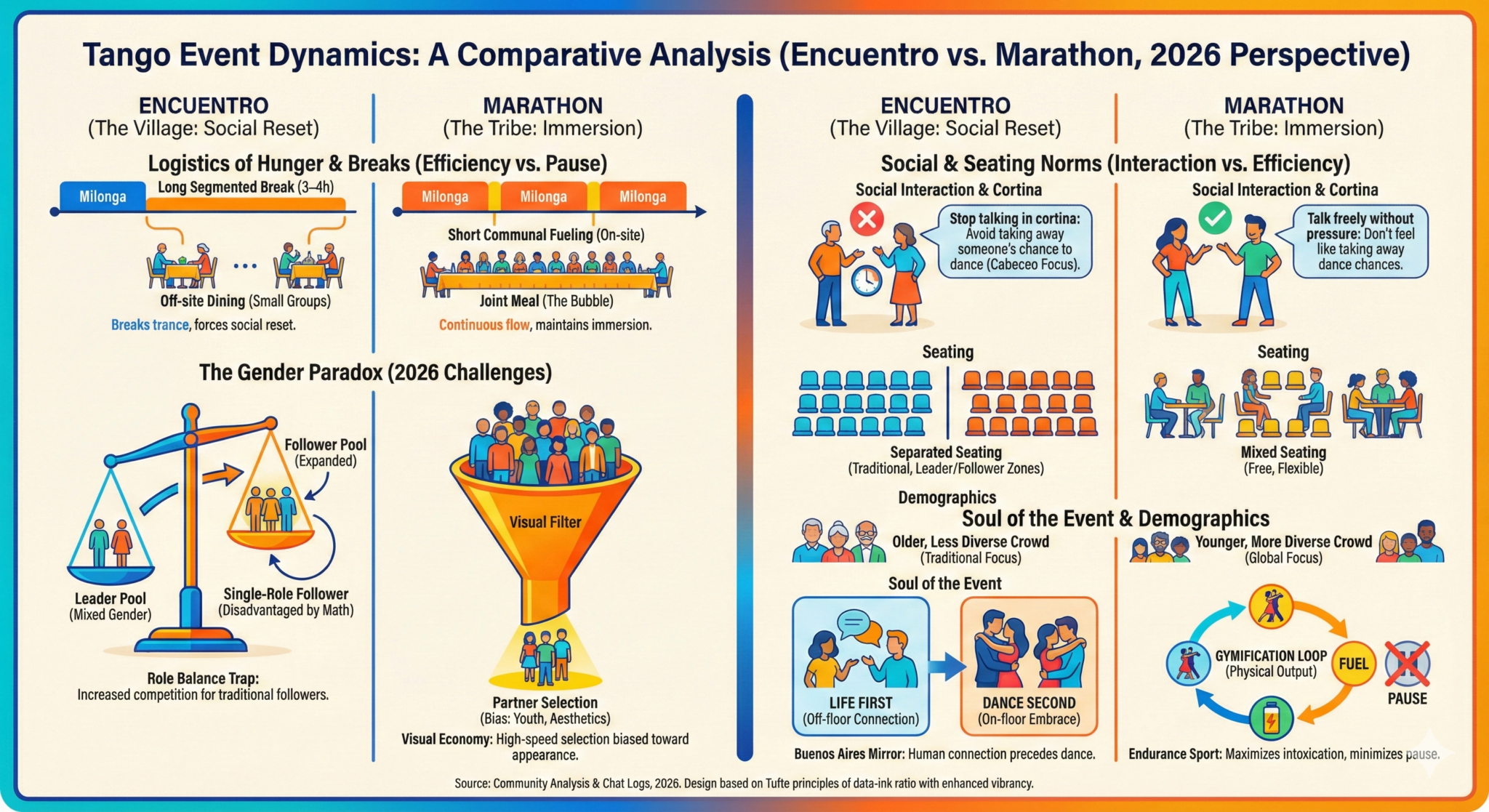
1. The Logistics of Hunger: Efficiency vs. The Pause
One of the most defining differences lies not just in the music, but in how we eat and rest.
- The Marathon (The Tribe): As “The Data-Driven Dancer” noted, marathons are designed for immersion. They often feature communal joint meals served on-site with only short breaks. The goal is efficiency: to keep the “tribe” together and the energy flowing. You eat, you chat with the room, and you get back to dancing. It creates a continuous “tango bubble” where the outside world ceases to exist.
- The Encuentro (The Village): Encuentros are defined by segmentation. They typically feature significant breaks (often 3–4 hours) between the afternoon and evening milongas. Participants usually leave the venue to dine in smaller groups at local restaurants. This breaks the “trance” of the event, forcing a social reset and allowing for intimate conversation before the evening begins.
2. The Gender Paradox: A 2026 Perspective
As we settle into 2026, the discussion highlighted that both formats present unique challenges for gender dynamics and inclusivity.
The Marathon: The “Visual Economy”
“The Veteran Maestra” offered a stinging observation: Marathons operate on a high-speed visual economy. Because the event is continuous and often attracts a younger crowd, partner selection can become biased toward “youth, beauty, and fashion.”
- The Reality: She noted that even highly skilled professionals can sit for hours at marathons if they don’t fit the visual archetype of the moment. The environment is high-energy, and without the social “glue” of long breaks or community standing, the visual element dominates.
The Encuentro: The “Role Balance” Trap
“The Traditional Milonguera” raised a crucial point about the evolution of Encuentros. In an effort to be progressive, many organizers have shifted from Gender Balance (equal men/women) to Role Balance (equal leaders/followers).
- The Shift: This has normalized female leaders and double-role dancers—a positive and necessary evolution for the dance.
- The Unintended Consequence: However, for the “traditional” woman who only follows men, the math has worsened. She is no longer competing for men against other women; she is competing for a shrinking pool of male leaders against a growing pool of female followers (some of whom are double-rolers switching roles). In 2026, the single-role female follower is statistically the most disadvantaged participant in the Encuentro ecosystem.
3. The Soul of the Event: “Gymification” vs. The Social Club
This brings us to the deeper philosophical question raised by “The Social Philosopher”: Do we really want to go to an event only to dance?
The “Gymification” of Tango
The Marathon model—continuous music, on-site refueling, endurance focus—can feel like the “Gymification” of tango. It treats the dance as a sport of physical output, where a break is seen as a loss of potential dance time. It maximizes the “intoxication” of the dance but minimizes the human pause.
The Buenos Aires Mirror
In contrast?, compare to the traditional Porteño social dynamic. In Buenos Aires, the milonga is a social club first. You go to see friends, to eat, to drink, and—if the mood strikes—to dance.
- The Encuentro’s structure—forcing you to leave the venue, have dinner with friends, and return—replicates this “life first, dance second” approach. It acknowledges that the best tandas often happen not because of physical perfection, but because of the human connection established off the dance floor.
- Or is it the other way around? Best tandas or exploration happen because you can socialize at the Marathon, enjoy the ambience, and dance without pressure?
The Bottom Line for 2026:
- Go to a Marathon if you want the “tribe” experience: staying on-site, communal feeding, high-energy endurance, and a focus on the physical act of dancing.
- Go to an Encuentro if you want the “village” experience: strict floorcraft, rhythmic music, and a structure that forces you to stop, go out for dinner, and actually meet people before you embrace them.