What Are the Basics, Anyway?
April 12, 2026· updated May 25, 2026
Marco posted a video blog this week[1] responding directly to a comment I’d left on one of his earlier posts.[2] I’d written that from the outside, he looked like he was also just selling “the real tango” — the same claim everyone makes. He pushed back: he’s not selling anything, he said. He’s sharing his experience as a milonguero, organizer, and teacher.
And then he asked a question aimed squarely at me and at anyone listening: is it acceptable for someone without a firm grasp of the basics to start teaching?
It’s a fair question. It also unravels the moment you pull at it.
I should say upfront: I’m responding as someone with over twenty years in tango, but not as a teacher and without an ambition to teach. Marco and I may have seen many of the same things over the years. We’ve just arrived at different conclusions.
Three Dancers, Three Answers
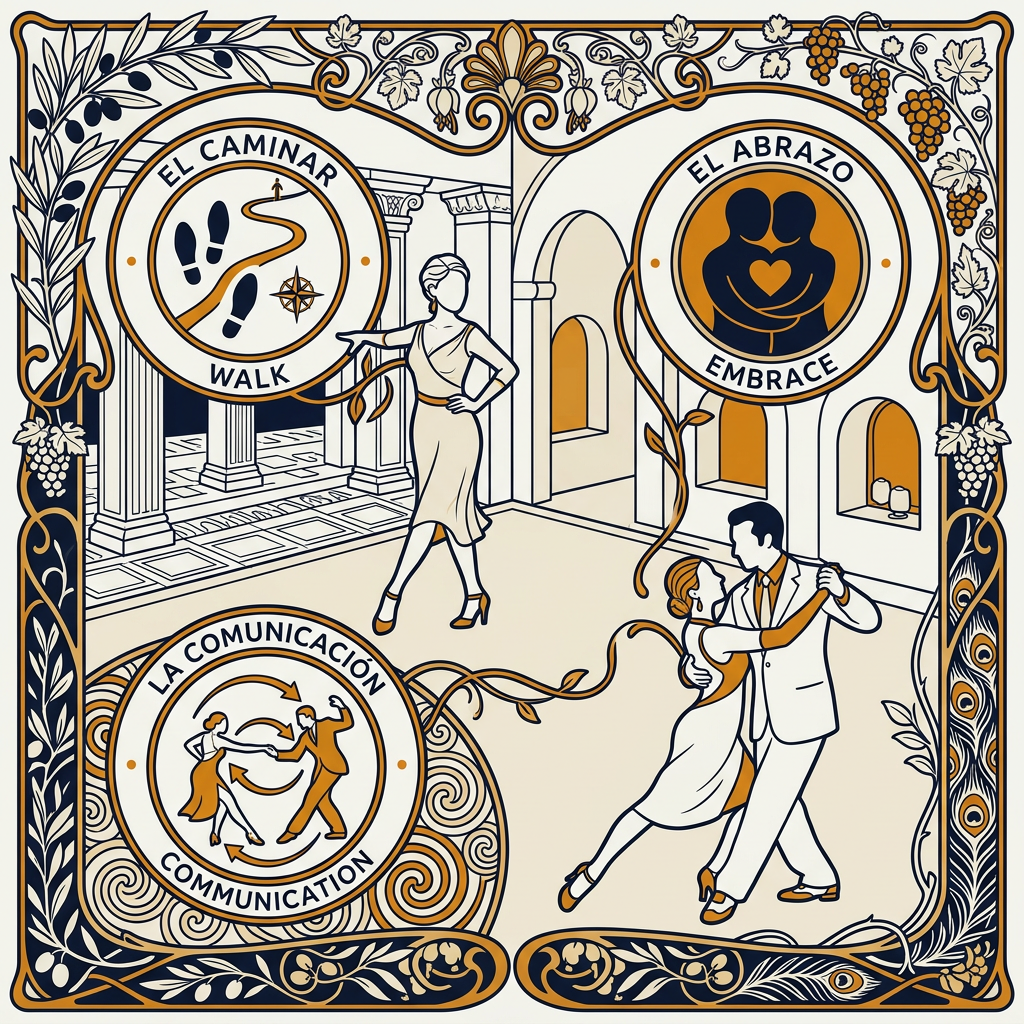
Put three experienced dancers in a room — people with twenty, thirty years on the floor — and ask them what the basics are. One says walking. Another says the embrace. The third says communication. They all nod. They all mean something different.
That’s not a failure of communication. It’s the nature of what we’re dealing with. These aren’t people who skipped class. They’ve spent decades refining their dance and their thinking about it. And yet, when you actually work with them — when you get past the vocabulary and into the body — you realize they’re not describing the same thing. They’re describing their own entry point, shaped by whoever taught them, wherever they danced, and whatever stuck.
The Performer Who Couldn’t Follow
Marco tells a story that’s hard to dismiss. At a three-day event with renowned performers and champions, one of them insisted on dancing with him. During the dance, she struggled to follow his lead — anticipating instead of listening, adding steps he never initiated. A performer. On stage in front of everyone. Teaching workshops. And she couldn’t do the thing the dance is built on.
I don’t doubt that experience. I’ve seen versions of it. We probably all have. And I can’t even know if what Marco experienced was a failure of fundamentals, or a failure of communication, or just a mismatch in styles. But I do know that the Milonga doesn’t care about credentials. It only cares about what happens when two people meet on the dance floor.
The Milonga Test
At a Milonga, none of the credentialing matters.
Strip it down to the raw experience. You can dance with someone who learned from a teacher with impeccable fundamentals. You can dance with someone whose teacher wouldn’t pass anyone’s basics checklist. You can dance with someone who never had a teacher at all — who learned at the Milonga itself, by doing it. And in all three cases, it either works or it doesn’t. The embrace either communicates or it doesn’t. The weight transfer either happens or it doesn’t. Maybe it works with one partner and not another. Maybe it works in one song and not another. Maybe it works in the first half of the dance and not the second.
The Milonga is the test. It’s the actual practice of our art. Not a syllabus.
That doesn’t mean teaching doesn’t matter — it obviously does. But it means the question “do they know the basics?” might be the wrong question. The better question might be: does what they do actually work when two people meet on a dance floor?
The Alphabet That Keeps Changing
Marco used an analogy I’ve heard before: basics are like the alphabet, and without the alphabet you can’t write poetry. It’s elegant. It’s also misleading.
Think about what happened over the last thirty years. The first wave of deep tango teaching in Europe came largely from performers — people from the Broadway shows, the stage tours. They crossed over into teaching and shaped an entire generation. Were they teaching “the basics”? Would what they described back then match what any of us call basics today?
No. Not even close.
Then came what people call Tango Nuevo.[3] Some describe it as a new way of dancing — open embrace, unconventional figures, modern music, a break from tradition. But plenty of the people involved in that movement describe it differently: not a new dance, but a new way of understanding the dance and how to teach it. Gustavo Naveira, Fabián Salas, and others started applying systematic analysis to tango movement — investigating why things work rather than just replicating what the old milongueros did. Even years later, that shift is still best described not as inventing a new tango, but as decoding the dance and building a teaching system.
And it didn’t stop there. Watch what Horacio Godoy does in his musicality workshops.[4] Even the workshop descriptions show how explicitly he teaches through orchestras, recording years, and historically differentiated styles. And the visual record exists too in archival projects that make older tango practice easier to compare with what we dance now.[4] When you look at milongueros from the 1930s to the 1950s, what you see differs significantly from what most people dance today. The posture is different. The rhythm is different. The embrace has different qualities. These were the masters, the people who invented the basics. And their basics don’t look like ours.
Biomechanics, movement science, somatic practices, ballet, contact improvisation, maybe even martial arts — all of these have fed back into how we think about tango over the past two decades. Teachers who came up in the 2000s think differently about the body than those who came up in the 1990s. Teachers working today think differently again.
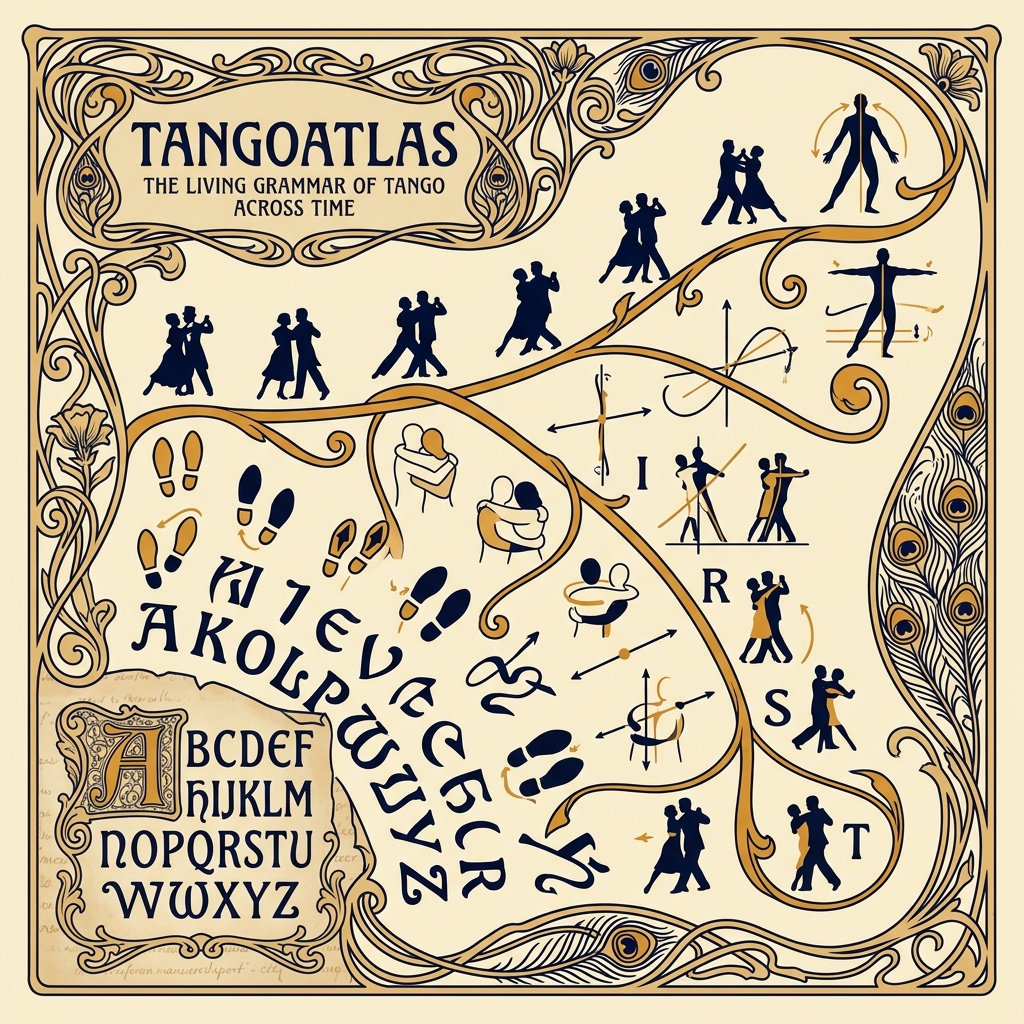
The alphabet analogy assumes a fixed alphabet. But tango’s alphabet is a living thing. Letters get added. Some get dropped. The grammar shifts. What Naveira analyzed in the late 1990s already looks different from what’s being taught as fundamentals in 2026.
Many Ways to Build
Walk into five different tango schools and you’ll see five different pedagogical architectures. One teacher builds from the feet up — grounding, weight, floor contact, then everything stacks on top. Another starts from the embrace and works down — connection first, movement second. A third works from the center outward — core, axis, then limbs and contact.
All of these produce good dancers. None of them is objectively correct. Each reflects a set of assumptions about what matters most, filtered through that teacher’s own experience and the traditions they inherited.
This is where the conversation gets genuinely interesting — and where reducing it to “should you know the basics before you teach” starts to feel too small. Whose basics? From which tradition? Using which model of the body?
Early Habits and the Path That Shifts
Marco also made a claim I want to engage with honestly: that just because someone starts their tango journey one way doesn’t mean they’ll find the right path. In his experience, this rarely happens — especially with leaders. Early habits stick.
He’s not wrong about the difficulty. Anyone who’s tried to change a deeply grooved movement pattern — a stiff arm, a habitual lean, a locked hip — knows how stubborn the body can be. Years of dancing a certain way builds neural pathways that resist rewiring.
But “rarely” isn’t “never.” And the dancers who do transform tend to do so not because they found a better basics checklist, but because something about their environment shifted: a new teacher who communicated differently, extended time in Buenos Aires, a practice partner who gave honest feedback, or simply enough Milonga hours to feel what worked and what didn’t. The path corrects — when the feedback loop is real.
And the feedback loop can also just be valid within one community, say “the marathons” or “the encuentros” which favor one style of dancing over others, reinforcing homogeneity rather than sharpening the breadth of what tango can be.
The harder question is whether the feedback loop is real often enough. And honestly? Sometimes it isn’t. Some communities are too polite, some partners too forgiving, some Milongas too dark to see what’s going on. Marco’s frustration about that is legitimate.
The Standardization Temptation
So – what are the basics? And what is the right way of the basics?
There’s always someone who suggests the answer is standardization. And fair enough — it’s been done before. English tango, the ballroom version, is one of the most codified dances in the world. Syllabi, grade exams, technique books going back nearly a hundred years.
But even that is a moving target. The broader British ballroom world was already standardizing tango in the early 1920s, and the Imperial Society of Teachers of Dancing made tango one of its first technical priorities in 1924.[5] The codification process had earlier roots too in books like Philip Richardson’s The Guide to Tango, and Victor Silvester’s Modern Ballroom Dancing, first published in 1927, anchored what became the English style for a generation. But the institutional record makes the same point either way: the standard kept moving.[5] Pick up one of those early manuals and compare it to what’s taught in a competitive ballroom studio today — the biomechanical understanding has shifted, the aesthetic has shifted, the very thing that was “standard” in 1930 would look strange on a competition floor in 2026. Nearly a century of standardization, and the basics still moved.
Standardization gives you something — consistency, a shared language, a way to measure. But it doesn’t solve the underlying problem, which is that our understanding of how bodies move is always changing. You standardize a snapshot. The dance keeps moving.
So What Are We Actually Discussing?
I’ve been turning this over, and I don’t think the question is only about basics. It’s also about what tango is — and that’s where it gets genuinely elusive. Even UNESCO’s heritage entry describes tango not just as a dance, but as music, poetry, community, and a cultural identity that keeps adapting as it moves.[6]
Is tango authentic, real, pure? A soul speaking to another soul? Or just a dance with aesthetic value — beautiful movement, nothing more? Is it a lifestyle or a hobby? Open work on authenticity, transnational tango, and tango imaginaries all points in the same direction: people are not only arguing about steps, but about meaning.[7] I’ve been through many of these stages myself over the years, and I’ve watched hundreds of dancers go through them too. Where you are in your tango journey shapes what you think the basics should be. A dancer in their third year and a dancer in their twentieth are often not even discussing the same dance.
Marco frames it as a quality problem — and he’s right that there’s a real concern underneath. There are teachers out there causing harm, not out of malice, but out of not knowing what they don’t know. People pick up injuries. People learn patterns that make them difficult partners. People get turned off tango entirely by a bad first experience.
But the answer isn’t a basics checklist. In fact, the answer is already forming in some places. In Germany alone, programs like Tangodesalon’s teacher training, Tango Argentino Köln’s Lehrertraining, WiDance’s Tangolehrer-Ausbildung, and the ADTV specialist track for Tango Argentino show that the community has already recognized the gap between dancing well and teaching well. Other countries have similar efforts too.[8] The catch? Each program defines the basics differently — which brings us right back to the fundamental question.
Teaching as a Journey
There’s an argument I’ve heard many times, and there’s real truth in it: teaching itself deepens your understanding of the dance. The act of explaining forces you to understand. The act of watching students struggle forces you to see what you’d stopped seeing in yourself. Some of the best teachers I’ve encountered became great through teaching, not before it.
Which leads to the most uncomfortable practical reality. In many local scenes — smaller cities, newer communities, places far from the tango capitals — there simply are no teachers with decades of experience and impeccable fundamentals. If you want to grow that scene, someone has to start teaching. Waiting for a master to appear isn’t a strategy. Bringing in external teachers every weekend isn’t affordable. So someone steps up, imperfect basics and all, and starts.
Is that acceptable? Marco might say no. I’d say it depends entirely on whether that person keeps learning — keeps going to festivals, keeps taking classes themselves, keeps being honest about what they don’t know. The sin isn’t starting with incomplete knowledge. The sin is stopping there and claiming that “the three steps they know is the essence of tango”.
Where This Leaves Us
Over the years I’ve learned there is never just one answer in tango. And rarely just one question. The deeper you go, the more elusive it becomes — unless you approach it philosophically or abstractly, which is what Marco’s initial question invites. “Should someone who hasn’t mastered the basics start teaching?” Depending on your perspective, the answer is either no or emphatically yes. Both can be argued. Both can be right.
Marco said he isn’t selling anything — just sharing what he knows and cares about. I believe him. And I think the fact that we’re having this conversation publicly, pushing back on each other’s assumptions, is exactly the kind of culture tango needs more of. Not agreement. Not standardization. But the willingness to argue about what matters — and then go dance.
>
Endnotes
For readers who want to go deeper:
- Marco’s latest response video: Facebook video post.
- The earlier exchange that triggered this article: Marco’s earlier Facebook post.
- On Tango Nuevo as analytical and pedagogical shift: Gustavo Naveira & Giselle Anne — Press, Gustavo Naveira — Bio, Naveira: Virtual chat with Gustavo and Giselle, Fabian Salas — I do not share the idea of Tango Nuevo, and CITA — About Us.
- On Horacio Godoy, historical musicality, and archival comparison: Musicality Course With Horacio Godoy, Horacio Godoy & Maricel Giacomini — Embrace Berlin, Horacio Godoy — Cleveland Tango School, and The Tango Archives — Daniel Trenner.
- On British and ballroom codification: History of Modern Ballroom — ISTD, The Ballroom Technique Syllabus — ISTD Shop, Modern ballroom dancing — National Library of Ireland, The British Dance Council Story, and Philip Richardson — The Guide to Tango (1914).
- On tango as a living cultural practice: Tango — UNESCO Intangible Cultural Heritage.
- On authenticity, transnational tango, and changing meanings: Discourses of Authenticity in the Argentine Tango Community of Pittsburgh, Dancing Tango: Passionate Encounters in a Globalizing World, Trading in Imaginaries: Locating Authenticity in Argentine Tango, and The movement of Argentine Tango: an ethnography of improvisation and transnationalism.
- On German and European teacher training: Tango Teacher Training — TTT Programme, Tangolehrer-Ausbildung — WiDance, Tango Lehrertraining — Tango Argentino Köln, ADTV Fachtanzlehrer/in für Tango Argentino, and Tango Teacher Training — Tango Amistoso.