When the World Gets Too Much, People Need Tango
June 4, 2026
In an era that moves at a relentless pace, we find ourselves constantly overwhelmed by information overload and an endless cycle of bad news. We are navigating economic pressures, gentrified cities, and a digital landscape largely driven by outrage culture, superficial interactions, and global unrest. As a result, the modern world can often feel loud, isolating, and profoundly exhausting.
In response to this chaos, people are quietly searching for an antidote. They are looking for small, safe sanctuaries where time slows down and genuine human connection is prioritized. There is a deep, universal craving for spaces that are physical, emotional, and intimate — environments that offer care, mutual respect, and a sense of balance and healing.
When the world gets too big and chaotic—make it small. Boundaries equal safety… (Coach Buck Grant)
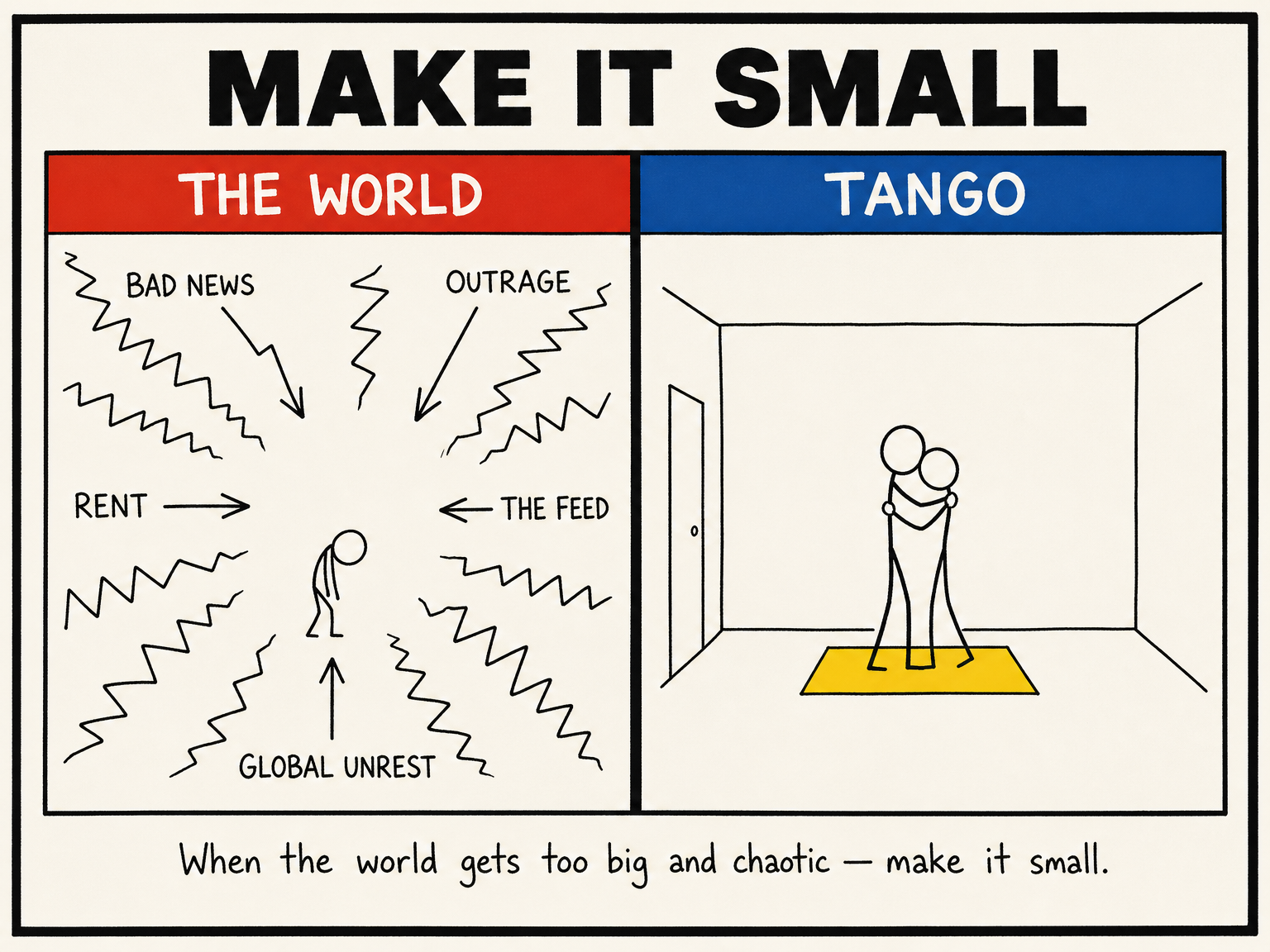
We know that tango provides exactly this. But the way we talk about it often gets in the way.
The “True Tango” Trap
Many teachers and tango influencers approach the dance from the angle of cultural authenticity — specifically, Argentine authenticity. True tango, in this framing, must celebrate Argentine culture, tradition, and lifestyle. It must honor the true Milongueros. Each of these ideas carries its own deep rabbit hole of history, mythology, and identity — most of which remains poorly analyzed and even harder to translate meaningfully into the global context of 2026.
This framing may genuinely attract some people. The mystery, the mythology, and the romance of Buenos Aires have real appeal. But let’s be honest: most Europeans dancing tango are not secretly reincarnated Argentinians looking to reconnect with their roots. They are people looking for something real, something warm, and something that belongs to them.
This is not about erasing history or culture. On the contrary — we should reach back with gratitude to everyone who created this extraordinary music and dance that we are still enjoying, or rediscovering, a hundred years later. That legacy is worth celebrating and preserving.
But it is 2026. And what makes tango truly attractive, genuinely beneficial, and yes — quietly addictive — has very little to do with cultural mythology.
What Tango Actually Offers
Tango is community. It is connection, movement, flow, and meditation. It is expression, communication, healing, distraction, balance, adventure, travel, beauty, and emotion. It is a space where you arrive as a stranger and leave feeling understood, without having spoken a single word.
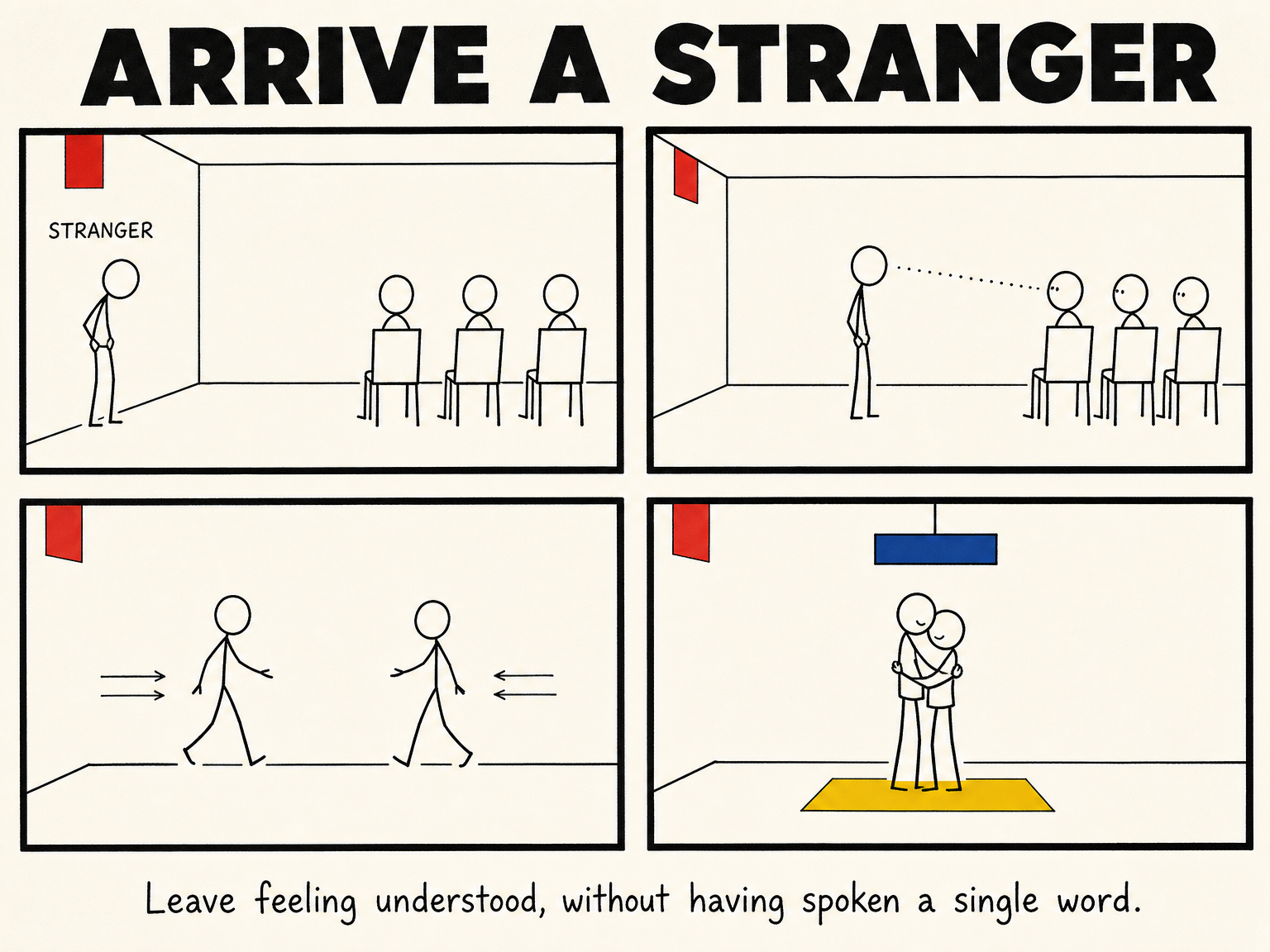
For all of that to happen, however, certain things need to be in place.
The most visible are the foundations of safe social interaction: the codigos, the cabeceo, floorcraft, and a shared culture of consent and respect. These are often presented as old traditions to be followed blindly, but their real purpose is deeply modern — they create psychological safety, clear boundaries, and a social contract that allows strangers to be genuinely intimate without misunderstanding or discomfort.
Equally important is infrastructure: the milongas, the practicas, the festivals, the workshops. These are the physical spaces where tango happens, where beginners find their footing and experienced dancers find their flow. Without local teachers and organizers, without visiting teachers and traveling dancers keeping the knowledge alive and moving, communities stagnate.
Ultimately, tango is local, not digital. It happens in the here, the now, and when we don’t have that, we don’t have tango anymore. (a participant in tango.connects conference 2025)
The Things We Talk About Less
There are also factors that rarely make it into the romantic narrative around tango, but are no less essential.
Money. Tango needs financial support to survive and grow. Spaces cost money. Teachers, DJs, live orchestras, and visiting artists need to be paid fairly. Without sustainable economics, even the most passionate communities slowly collapse. We cannot put that burden only on people who are living precariously (the dedicated artists), or working a cat-food-job so that everyone else can enjoy tango.
Critical mass. A tango community needs enough people — at enough different levels — to function well. Beginners need teachers and a welcoming environment. Advanced dancers need peers and challenges and inspiration. Events need enough attendees to create the atmosphere that makes tango feel alive. Without critical mass, communities become insular and fragile.
New blood and new ideas. Perhaps most importantly, tango needs fresh energy. Communities that stop welcoming newcomers — whether consciously or through an atmosphere of gatekeeping and elitism — eventually become a small circle of familiar faces, growing older together, reminiscing about better days. That is not a community. That is a slow goodbye.
So: How Do We Tell This Story?
Today’s world is loud, anxious, and exhausting. Many people are actively searching for exactly what tango offers — and they just don’t know it yet. Their only reference point is the cliché: red roses, fishnet stockings, a fedora, and a dramatic dip.
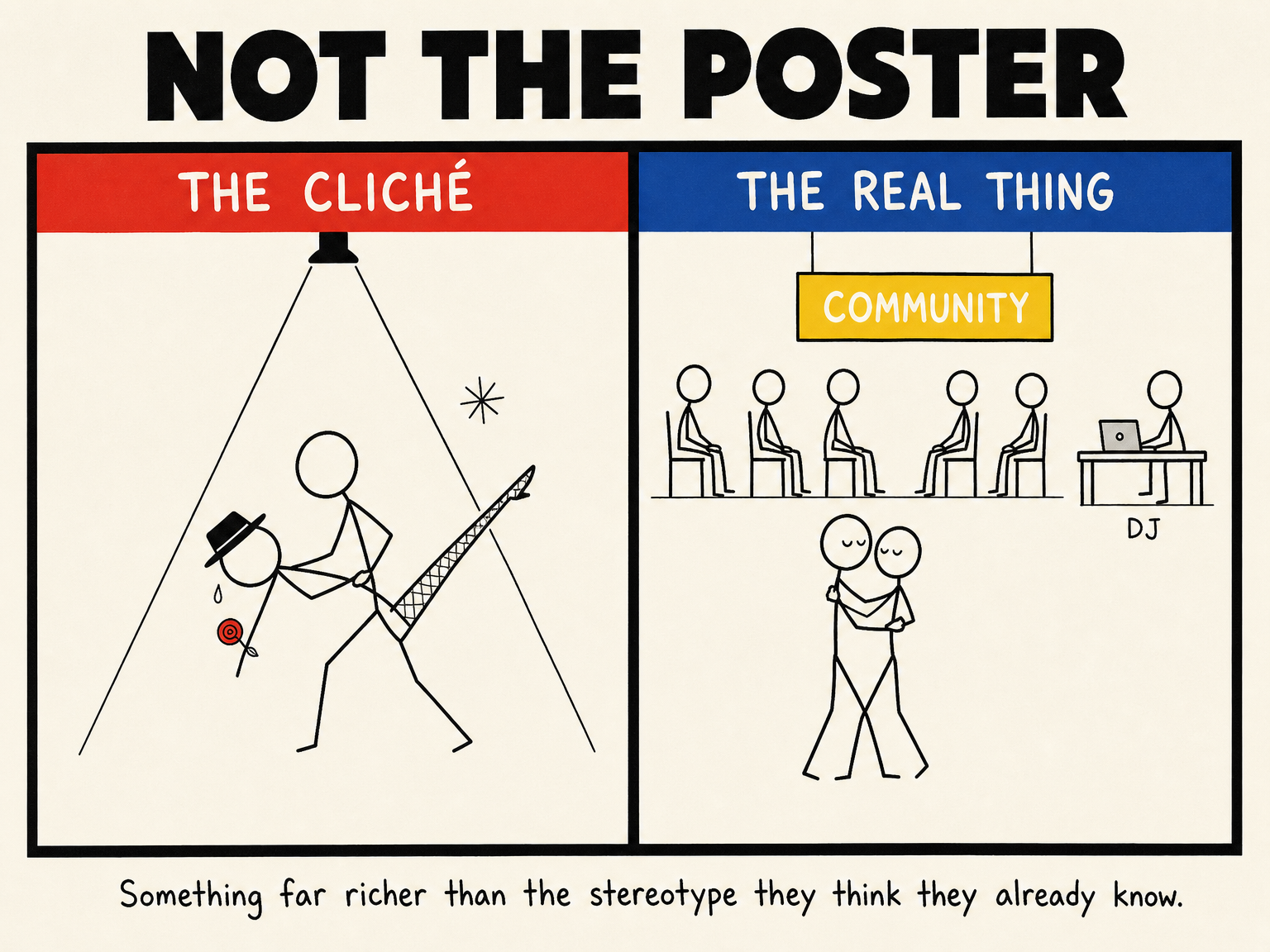
Our challenge — as teachers, organizers, and dancers — is to bridge that gap. To tell a story about tango that speaks directly to what people are actually missing in their lives. A story about a safe social world, about physical connection without performance pressure, about learning to listen with your whole body, about belonging to a community that travels the world together.
How do we bring all of this into our message — and invite people into something far richer than the stereotype they think they already know?