Traditions as Best Practices
June 6, 2026
This is a continuation of my previous thoughts on how we present tango in 2026. The initial text sparked an productive discussion on Facebook. Among the many voices, one specific comment from Matias prompted me to continue writing.
Matias argued that the traditions of tango are exactly what brought tango here into 2026. They essentially are what tango is, and cannot be separated from it. If we separate tango from its traditions, it loses its essence and unique positioning, as other “hobbies” can deliver similar results. He also rightfully argues that the visible components of tango—the clichés and aesthetics—actually work: they bring people in, and even non-dancers recognize tango when they see it.
I interpret Matias’s comment not as pushback, but as a request to clarify. It triggered me to read what I wrote again, because I wasn’t trying to say “ditch the traditions.” What I am saying is: let’s find a way to talk and think about tango in a language and posture that belongs in 2026, rather than starting fights about who understands the essence of tango better, or who is a “true Milonguero” and who is not.
Tradition
Tradition is defined as a “belief, principle, or way of acting that people in a particular society or group have continued to follow for a long time.” (Cambridge Dictionary).
Maybe my take on tradition is like the reinvention of a traditional recipe—like my grandmother’s Black Forest Cherry Cake. I still bake it using the traditional essence, but with the ingredients, techniques, and requirements of today’s kitchens: less sugar and fat, more foam less cream, more focus on flavor and texture, and using a kitchen machine rather than mixing it all by hand.
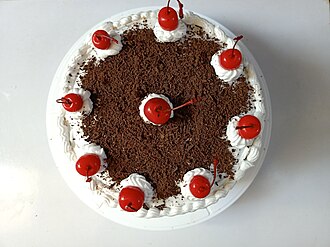
(Source: Keerthiga, CC BY-SA 4.0

Ultimately, it is still the traditional cake, but interpreted in a way that I can relate to better, and enjoy more. But of course whenever I make the cake, I cherish the memory of my grandmother, and I do share stories and “mythology” with my guests.
What makes tango different from all the other activities that also provide connection and community?
He is right to ask. If you only want physical connection and movement, Contact Improvisation provides it faster. If you want community and joy, Salsa or Swing are arguably easier to enter. If you seek flow and meditation, Ecstatic Dance or Partner Yoga have far lower barriers to entry.
So what is tango’s Unique Selling Proposition (USP)? Why do people endure the steep learning curve?
Of course, there are probably as many individual reasons as there are dancers, so generalizing is difficult at best (and we lack the hard data to fully understand it). But for me, and many others, it is the profound intersection of complexity and emotional bandwidth.
Tango demands an intricate, wordless dialogue between two bodies navigating within the confined space of the embrace, (and sometimes even a shared axis). It is paired with traditional music that offers an unmatched depth of melancholy, tension, and resolution. People stay because this specific combination of deep structure, musical complexity, and emotional range simply does not exist in traditional ballroom or other social dances.
At the same time, we have a thriving scene dancing tango mechanics to alternative, non-tango music. This allows for a completely different emotional expression and a distinct kind of freedom. Does this still qualify as “tango” (and certainly not as “true tango”, right?)? That is a debate for another day. But we cannot disregard it, because it proves a vital point: the mechanical and social structure of the dance works beautifully, even when detached from its traditional Argentine soundtrack. And visually, a stranger would still recognize it as Tango.
From Tradition to Best Practices
My argument in the first post was never against tradition itself, but against using a romanticized, 1930s mythology at the entry door, or using it as the only guiding light for all that we do.
But it is 2026. And what makes tango truly attractive, genuinely beneficial, and yes — quietly addictive — has very little to do with cultural mythology.
The social contexts we still use today (essentially the tango traditions) survived because they work. They are highly effective at helping us create the experiences we cherish.
If we look closely at the “traditional” elements of tango, they are actually sophisticated tools designed to make tango work in a social setting. Together, they form a social contract that allows strangers to experience deep intimacy safely.
Here is what happens when we translate the mythology into modern infrastructure:
| Traditional Element | Modern Translation | Core Function in 2026 |
|---|---|---|
| Cabeceo / Mirada | Opt-in Consent Framework | A distance-based, non-verbal protocol that prevents social friction, eliminates the pressure of direct physical approaches, and provides a face-saving rejection mechanism. |
| Ronda & Floorcraft | Shared Traffic Algorithm | A dynamic, self-regulating spatial system that prevents collisions, allowing dancers to achieve moving meditation without constantly scanning for danger. |
| Abrazo (Close Embrace) | Somatic Co-Regulation | A physical framework for shared axis and groundedness, providing emotional safety and deep non-verbal communication. |
| Códigos | Behavioral Social Contract | A baseline set of community guidelines ensuring psychological safety, predictability, and mutual respect on a crowded floor. |
So what?
Is this just turning words around without any applicability for the real world?
Not at all. Let me come back to my grandmother’s cake.
The way tango is experienced today clearly honors the essence of the dance. But over the decades, a lot of the “how” has changed significantly, even if the “what” might still look like the original to an outsider. What we fiercely defend as “tradition” today is, in reality, the result of continuous, deliberate upgrades.
Consider just three examples:
- Teaching and Dance Technique. Our understanding of biomechanics and didactics has fundamentally changed. The dance we practice today has far less in common with the tango of 1930 than many care to admit. The Tango Nuevo movement started with exactly this goal: to analyze and understand the dance so it could be taught in a systematic, accessible way—a sharp contrast to the anecdotal, “just follow my lead” way people learned before. Yes, this was disruptive at the time, but today it has become the tradition. Most teachers today rely on structural concepts developed in the 1990s, not the 1930s.
- The Cabeceo and Mirada. (edited) In the early 2000s, it was barely practiced in many communities outside of Buenos Aires. For many dancers in Europe, it was the rise of the Encuentro Milonguero—a distinctly modern, European event format—that refined and perfected this practice, and exposed dancers to an environment where Mirada and Cabeceo were not an exception but the norm. Today, a room full of people can find dance partners across a crowded hall, without exchanging a single word, in a matter of seconds. It looks like magic to an outsider, but it is actually a highly optimized social system. There are many legends around why and how it became a social standard. But the reasons why remain the same across the century of tango history.
- Music, Tandas, and Cortinas. At no point in the history of tango has there been as much variety, curation, and choice in how music is presented at a milonga as there is today. The modern DJ, carefully architecting emotional arcs through tandas and cortinas, is largely a modern construct. There is no historical example that perfectly matches what we do now—yet we somehow believe that the “traditional milonga” has looked exactly like this since the dawn of time.
So, no, this is not just playing with words. Acknowledging this reality frees us from the dogma of the past.
Yesterday’s disruptive innovations—like systematic didactics or the Encuentro format—became today’s beloved traditions simply because they solved real problems and made the experience better. The pioneers of these movements didn’t just preserve tango; they built better infrastructure for it, and made tango better by questioning the form, and exploring and distilling the essence.
Honoring tradition doesn’t mean to stop changing. It means to transform the essence of yesterday so we can cherish it today, and make it ready for the future. Tradition is a process, not a state.
Notes
- I don’t have any facts or details, just anecdotes. ↩