What Happens When a Platform Dies?
March 23, 2026
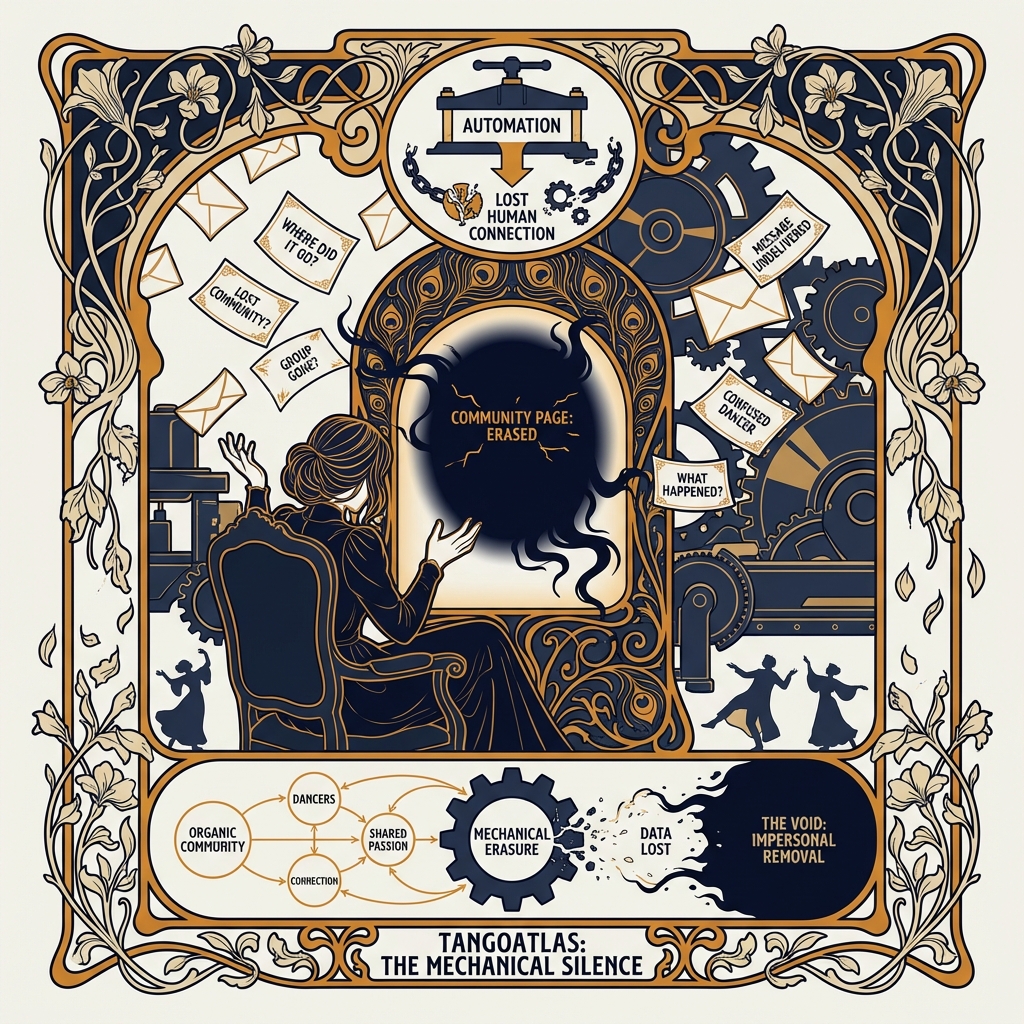
In October 2019, Facebook ran automated content moderation sweeps that removed thousands of community pages globally — and non-English-language communities got hit hardest. Researchers have since confirmed this in peer-reviewed studies: Facebook’s 2019 classifiers were structurally unequal, with documented overtriage of Arabic, Amharic, and other non-Western language communities (Technology Science, 2025; Modern Languages Open, 2023).
Pages across Europe and South America disappeared overnight. No warning. No explanation. Years of event archives, discussion threads, photo albums, member lists — gone. Organizers woke up to blank screens and confused messages from members asking: “where did our group go?”
The peer-reviewed numbers are striking: a 2025 study found that Facebook’s 2019 automated classifiers produced a 77% misclassification rate for Arabic content in the MENA region (Technology Science, 2025). In 2019, only 4 of India’s 22 official languages had operational hate speech classifiers at all. The system wasn’t malfunctioning — it was working exactly as designed for English, and failing structurally for everyone else.
Some pages came back after appeals. Many didn’t. The ones that did come back had lost their entire post history.
And the really devastating part? Almost nobody was surprised.
The Graveyard of Platforms
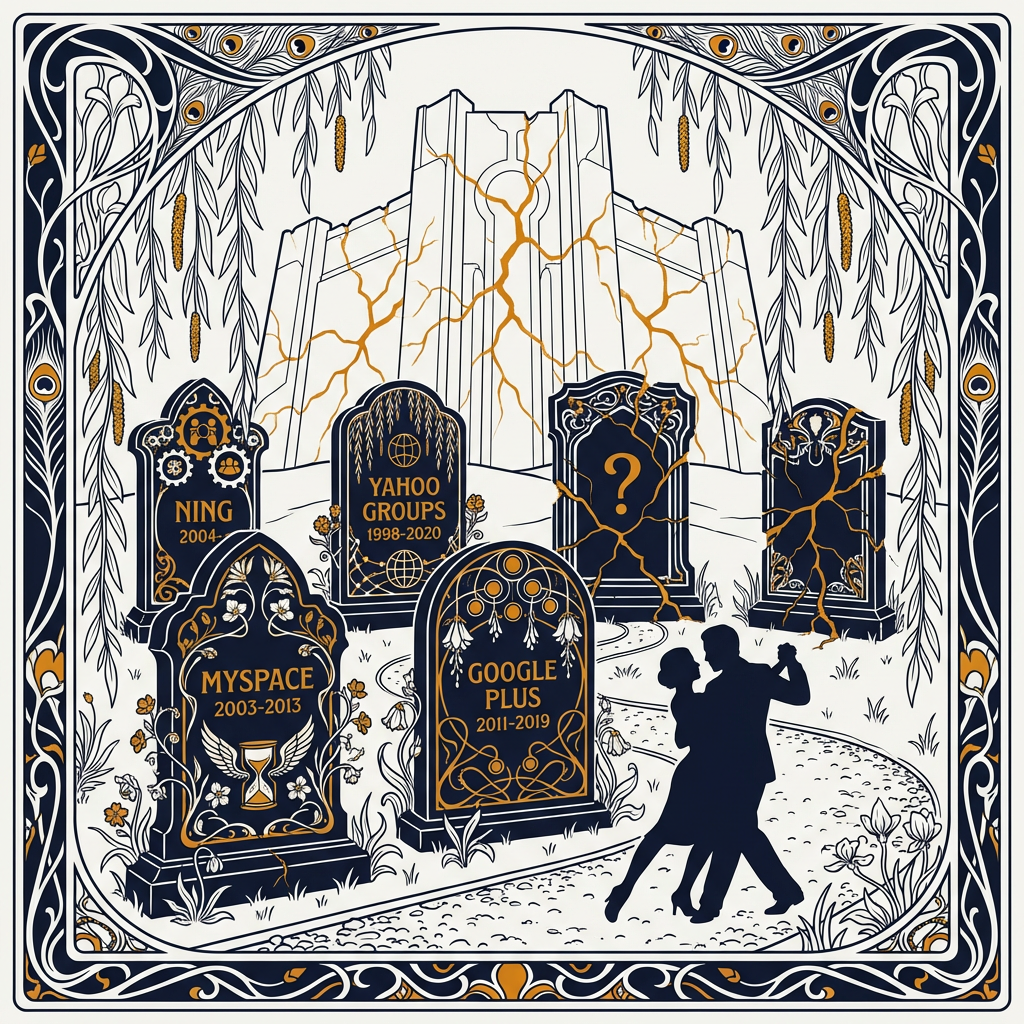
Let me take you on a quick tour of platforms that tango communities have relied on — and lost.
Our community’s digital life actually predates the platform era entirely. In 1995, tango dancers around the world were already connecting through Tango-L — a LISTSERV mailing list hosted at MIT, spanning six continents, with no investors, no algorithm, and no single entity who could shut it down. Its archives remained searchable for decades. Then, gradually, we migrated to platforms — for the reach, the photos, the convenience. That’s when the loop below began.
MySpace (2003–2009, peak). The first major social network. Tango DJs shared playlists and mixes. Teachers promoted their workshops. In 2019, MySpace revealed that a server migration had destroyed approximately 50 million songs by 14 million artists, along with photos and videos uploaded between 2003 and 2015. Twelve years of content — gone.
Google+ (2011–2019). Google promised it would be different. It was. It was worse. They shut it down after Google VP Ben Smith disclosed internally that 90% of user sessions lasted less than five seconds. Tango discussion communities that had migrated from Yahoo Groups to Google+ had to migrate again — losing members and history each time.
Yahoo Groups (1998–2020). For over a decade, this was the backbone of English-language tango discussion globally. Tango-L, Tango-A, regional groups — tens of thousands of posts about technique, music, history, travel. At its peak, Yahoo Groups hosted 10 million groups with over 115 million users. Yahoo removed the ability to post in 2019. It began mass-deleting archives in December 2019 — historians scrambled to save what they could with the Wayback Machine — and the platform itself shut down completely in December 2020.
Meetup (2002–present, but changed). Still alive — but the economics shifted hard. Acquired by Bending Spoons in January 2024, organizer fees more than doubled post-acquisition, with monthly plans running over $50 for many organizers (Follow the Money, 2025). Organizers who stopped paying lost access to their member lists and event management tools.
Ning (2005–2016). Several tango community networks ran on Ning’s free platform. When Ning discontinued the free tier in April 2010, laying off over 40% of staff, those communities either paid quickly or vanished. Most vanished. Ning’s parent company collapsed in 2016.
Skool (2019–present). Worth naming here not because it has failed — it hasn’t — but because it clarifies the structural problem. Skool is venture-backed. Several tango organizers have recently moved their communities there to escape Facebook’s algorithmic suppression of organic reach, and those communities are, by most accounts, genuinely thriving. The escape is real: Skool’s feed isn’t governed by the same reach-throttling system as Facebook Pages. One tango community of around 2,000 members I’m aware of made exactly this move. But the structural conditions that make platforms precarious transferred with them: the member list cannot be exported, community history is held inside a private silo Skool controls, and the platform — like every other venture-backed company — will eventually need to generate returns for its investors. Nothing in Skool’s terms prevents the same fee increase, algorithmic shift, or shutdown that’s hit every other platform in this list. The community solved today’s problem. It hasn’t solved the structural one.
You see it, right?
The Pattern Is Always the Same
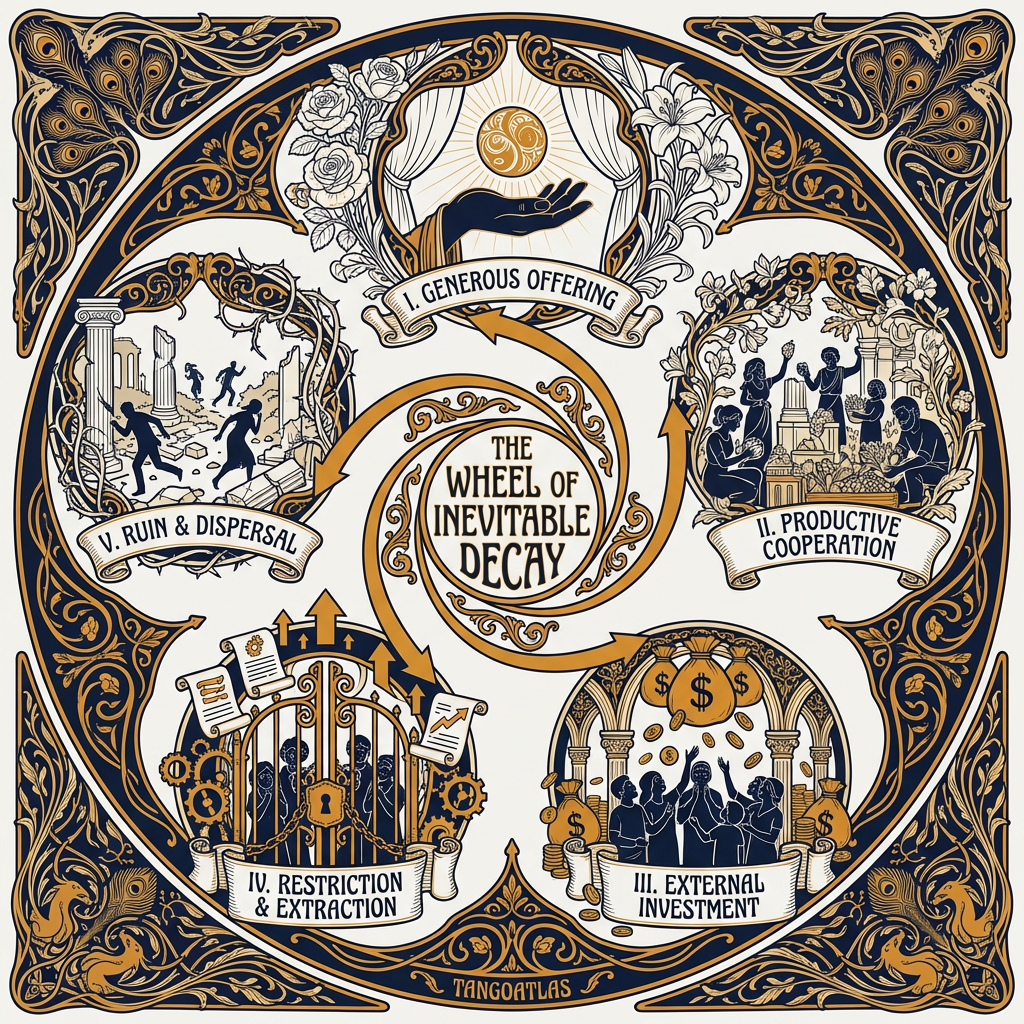
- A platform offers something genuinely useful — usually free
- Communities build their presence there, because that’s where the people are
- The platform grows, takes investment, needs to monetize
- The rules change — via fee increases, algorithm shifts, degraded experience, or outright shutdown
- Community content, connections, and history are lost or trapped
I wrote about enshittifciation already — Doctorow’s term for this cycle — in an earlier post. What matters here is that researchers have documented the pattern empirically: the primary causes of community exodus from a platform are policy changes, monetization shifts, and degraded user experience — in that order (Fiesler et al., CSCW 2020). Researchers at Ethics and IT have since argued that platform decay causes documented cognitive and moral harm to the communities that depend on them (Ardoline & Lenzo, 2025).
We’ve watched this happen, platform by platform, for twenty-five years.
Memory Loss Is the Real Cost
When I talk to organizers about platform risk, they usually think about the inconvenience of migration: “ugh, I’d have to move my group somewhere else.”
But that’s not the real cost. The real cost is memory loss.
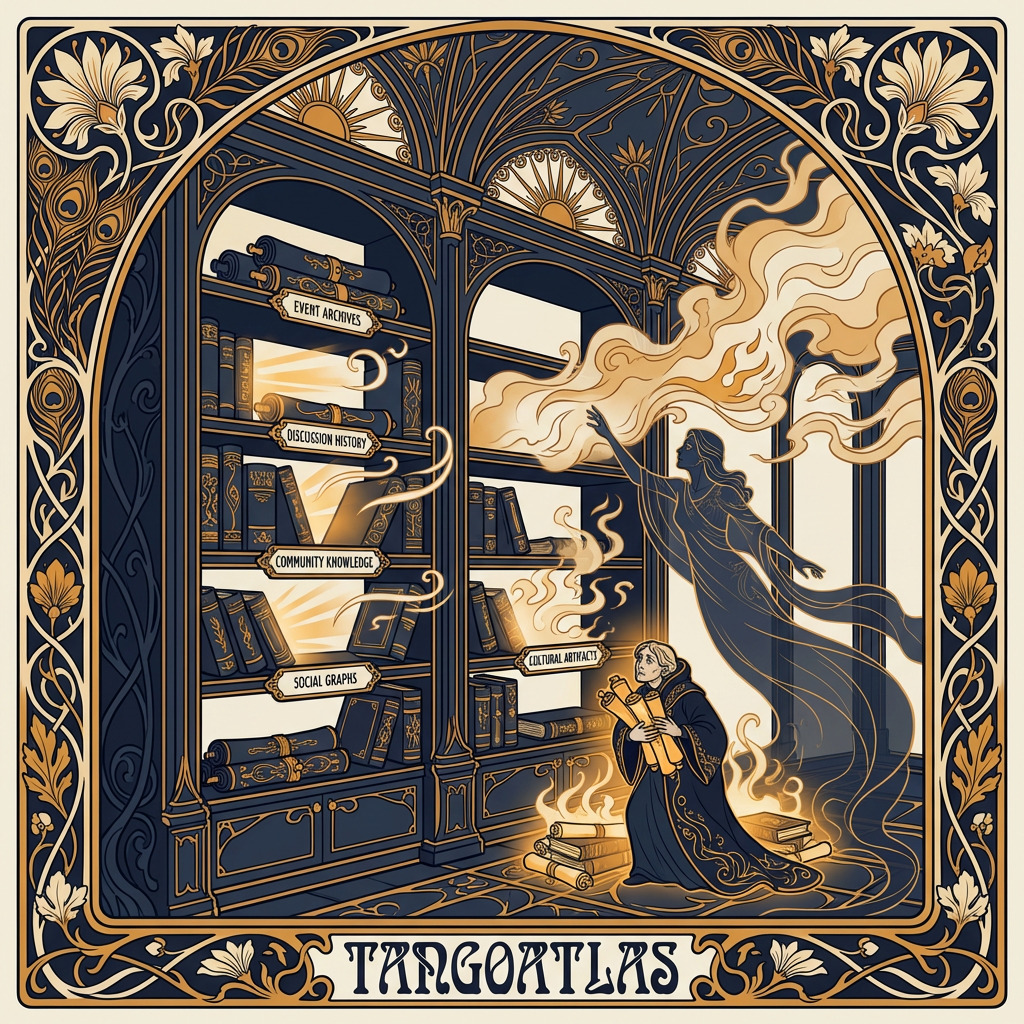
When a platform disappears, it doesn’t just take your upcoming events. It takes:
- Years of event archives — the record of who came where, which festivals happened when, which DJs played which tandas
- Discussion history — debates about technique, music selection, community governance
- Community knowledge — the FAQ that built up over time, the advice threads, the recommendations
- Social graphs — the connections between people, built over years of interactions
- Cultural artifacts — photos, videos, playlists, posts that documented a living community
Internet historians have mourned this explicitly. When Yahoo Groups deleted its archives, NPR covered it as a cultural preservation crisis — not just a tech story. Anirvan Chatterjee, founder of the Multicultural Genealogy Network, described the deletion this way: “It felt like somebody was going into my life, into my history, into my community histories and just hitting the delete button.”
The Internet Archive’s Community Webs program — now involving more than 270 public libraries across 46 US states — has been trying to hold the line, preserving social media posts, community websites, and local civic history that would otherwise disappear. They’ve archived more than 100 terabytes of material. It’s remarkable work. And it’s rescue archaeology — not a substitute for communities owning their own data in the first place.
I wrote my first post in this series about how tango communities are disappearing in demographic terms. But there’s another kind of disappearing that’s already happened, quietly: the historical record of our communities, scattered across dead platforms and decaying servers.
A researcher in Buenos Aires told me she’s been trying to reconstruct the early history of tango communities online. Much of it existed only on Yahoo Groups and early forums. She’s working with cached pages and the Wayback Machine. Most of it is simply gone.
Resilience Means Not Depending on a Single Point of Failure
The engineering term for what we need is “resilience” — the ability of a system to survive failures without losing everything.
A resilient community infrastructure has these properties:
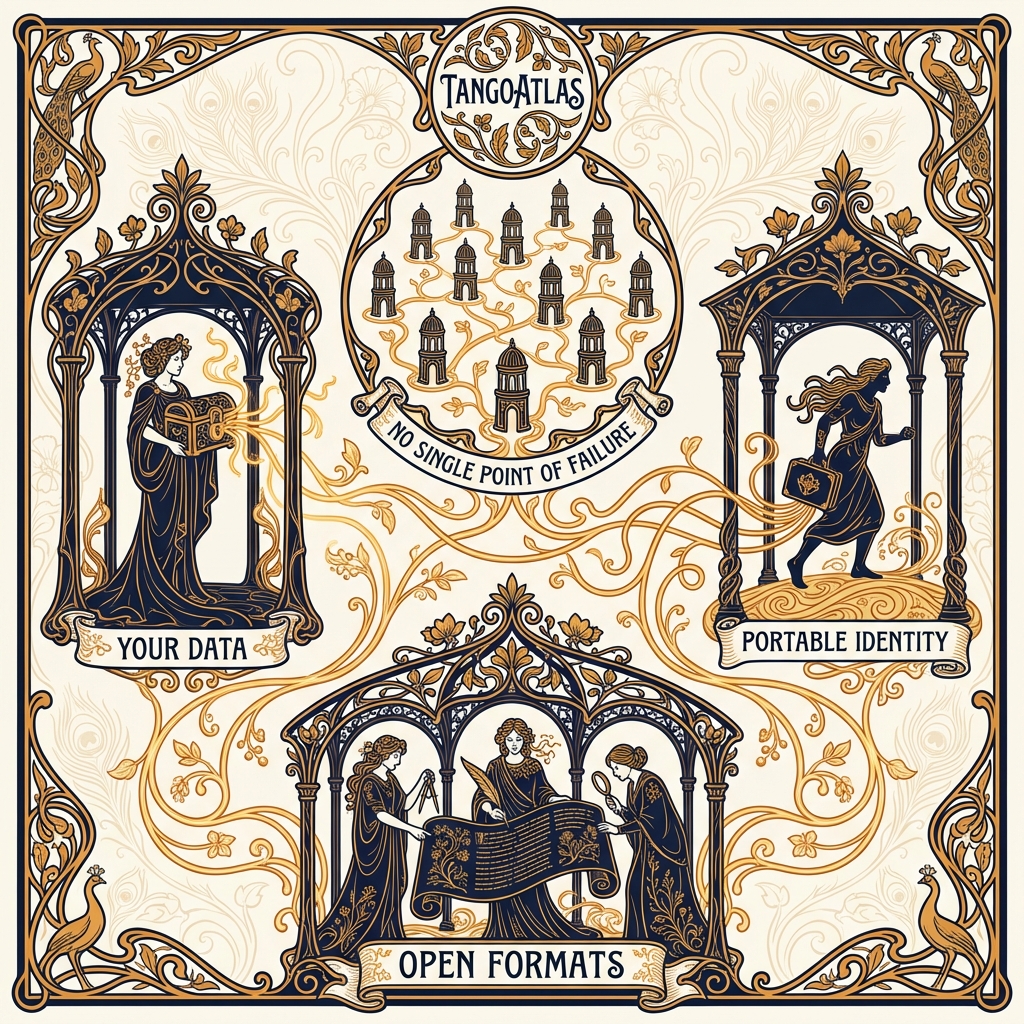
Your data is yours. Not “stored on your behalf” by a company — actually yours. Downloadable. In standard formats. Exportable to any other system.
No single point of failure. If one server, one company, or one platform goes down, the community survives because connections exist in multiple places.
Portable identity. Your reputation, your connections, your content history — these should move with you when you change platforms. Not start from zero each time.
Open formats. Your event data, your posts, your member directory — stored in formats that any software can read, including software that doesn’t exist yet.
Is this how Facebook works? Is this how any mainstream platform works?
No. That’s the problem. And “just move to a different platform” is not the answer — Skool, Discord, and whatever comes next all have the same underlying structure: someone else owns the infrastructure, and your community’s survival depends on their business model staying intact.
The Surprising Part: We’re Actually Good at This
Here’s something the research showed me that I didn’t expect.
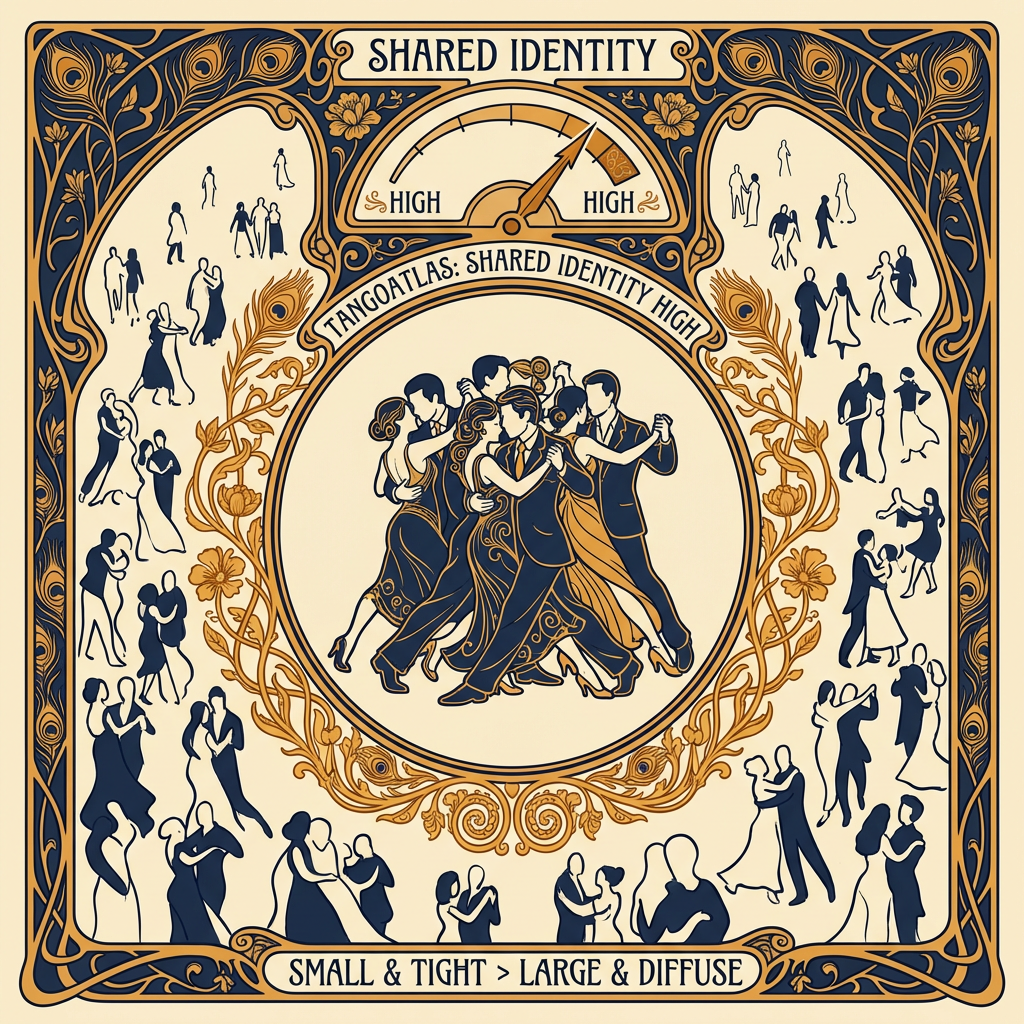
A 2023 study in Scientific Reports looked at what predicts successful community migration away from a platform. The single biggest factor — explaining 57% of the variance in migration success — was shared identity and commitment to a specific community (La Cava et al., 2023).
In other words: niche communities with strong shared identity migrate better than general audiences. Fan communities outperform general interest groups. Specialized forums beat mainstream social networks.
Tango communities check every box. We’re a small, passion-driven niche. Our identity is unusually specific — not just “I like dance,” but a shared aesthetic, a shared history, a shared set of values about how to do this well. Our communities have navigated decades of disagreement and held together.
We’re not the worst candidates for building platform-independent infrastructure. We might be among the best.
What Actual Resilience Looks Like
Let me paint a concrete picture.
Carlos organizes milongas in Cologne. Today, he posts his events on Facebook, because that’s where the dancers are. If Facebook deletes his page (again), he loses everything.
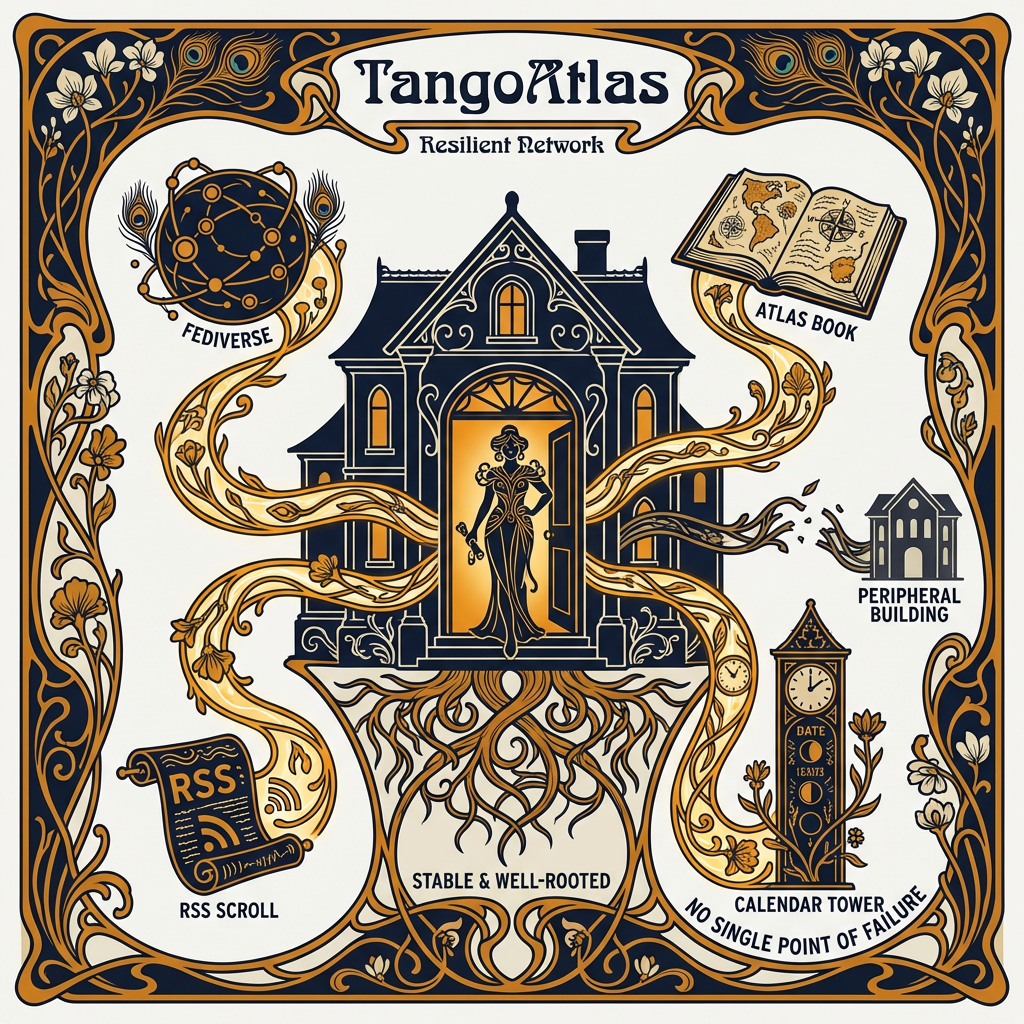
Now imagine Carlos runs a simple WordPress website. He posts events there. The website has an RSS feed (automatic), an ActivityPub plugin (free, takes a few minutes to install), and regular backups to his own storage.
Dancers find his events through multiple channels: his website, federated posts in the fediverse, aggregation on open directories, and — yes — shared links on Facebook. But the source of truth is his website. On his server. Under his control.
- If Facebook goes down: his events still exist on his site and in the fediverse.
- If his web host goes down: he has backups and can restore to any other host.
- If a directory goes down: his website and fediverse presence still work.
- If any single node fails: the others still stand.
No single failure kills his community presence. Nobody needed to grant him permission to build this. He didn’t need to petition a platform or wait for a policy change. He used open standards that exist specifically so that no one company controls them. That’s what resilience looks like.
Is the fediverse a proven replacement for Facebook’s reach? Not yet. As of 2025, the full fediverse has roughly 14 million users across 18,000 servers — compared to Threads’ 300 million or Facebook’s three billion. And Mastodon’s own data shows a significant engagement gap: 9 million registered accounts but fewer than 1.5 million monthly actives. There’s also a historical caution worth naming: XMPP, the open messaging standard that Google and Facebook once joined, was progressively de-federated by both companies once their networks were self-sustaining. Open protocols don’t guarantee open participation.
That said, the first large-scale empirical study of ActivityPub federation — tracking 20,000+ Threads users and 20,000+ Mastodon users over a ten-month period following Meta’s March 2024 integration — found that posts, replies, and likes successfully crossed the platform boundary at scale, with users on each platform maintaining autonomy on their home server (Jeong et al., 2025, arXiv:2502.17926). XMPP failed partly because it predated the architectural protections ActivityPub was specifically designed to provide. Whether corporate incentives will eventually override those protections, we’ll see.
The argument for decentralized infrastructure isn’t that it’s already won. It’s that it’s the only architecture that can win — where “winning” means your community’s survival doesn’t depend on someone else’s business model staying intact.
“But That Sounds Like So Much Work”
It’s less work than rebuilding from zero when a platform dies. Which most of us have already done at least once.
The tools exist. Most of them are free. Most of them are easier than setting up a Facebook Business Page — which, if you’ve done it recently, you know is genuinely not simple.
The real barrier isn’t technical. It’s habit. We’ve trained ourselves over fifteen years to equate “having a community online” with “having a Facebook group.” It takes a deliberate choice to think differently.
Here’s one external signal worth noting: the EU’s Digital Services Act — which came into full force in early 2024 — now holds large platforms legally accountable for exactly the kind of moderation failures that cleared out tango pages in 2019. Fines up to 6% of global annual turnover. That regulatory pressure exists precisely because regulators recognized what communities learned the hard way.
But regulation is a backstop, not a solution. The real answer is building infrastructure that doesn’t require anyone’s good behavior.
Look at the graveyard behind us: Yahoo Groups, Google+, MySpace, Ning, and — mark my words — eventually Facebook too, at least in its current form. Every platform in that list once seemed permanent. Every platform in that list has already changed or died.
The question isn’t whether our current platforms will change. They will. The question is whether our communities survive when they do.
Given what the research shows about how well tight-knit communities migrate — I’m genuinely optimistic. But only if we build the infrastructure now, while we still have the choice.

This is part of a series exploring digital infrastructure for tango communities. Previous: The Boring Infrastructure That Sets Tango Free. Next: Digital Sovereignty Is an Insurance Policy.
Sources
- Facebook 2019 moderation sweeps — peer-reviewed: Technology Science, 25 Feb 2025. https://techscience.org/a/2025022501/
- Facebook moderation — Ethiopia case, October 2019: Modern Languages Open, 2023. https://modernlanguagesopen.org/articles/10.3828/mlo.v0i0.468
- Facebook moderation — Brennan Center: Ángel Díaz & Laura Hecht-Felella, “Double Standards in Content Moderation,” Brennan Center for Justice, August 2021. https://www.brennancenter.org/our-work/research-reports/double-standards-social-media-content-moderation
- MySpace data loss: BBC News, 18 March 2019. https://www.bbc.com/news/technology-47610936
- Google+ shutdown: The Verge, 2 April 2019. https://www.theverge.com/2019/4/2/18290637/google-plus-shutdown-consumer-personal-account-delete
- Yahoo Groups — cultural loss: NPR, 9 December 2019. https://www.npr.org/2019/12/09/786469397/internet-historians-mourn-loss-of-cultural-record-as-yahoo-deletes-group-archive
- Meetup acquisition: Willkie Farr & Gallagher, 24 January 2024. https://www.willkie.com/news/2024/01/willkie-advises-bending-spoons-on-acquisition-of-meetup
- Meetup fee increases: Follow the Money (Dutch investigative journalism), 2025. https://www.ftm.eu/articles/wetransfer-owner-buys-up-apps-then-makes-them-more-expensive
- Ning free tier shutdown: TechCrunch, 15 April 2010. https://techcrunch.com/2010/04/15/nings-bubble-bursts-no-more-free-networks-cuts-40-of-staff/
- Enshittification and platform harm: Ardoline & Lenzo, “Platform Enshittification and Moral Harm,” Ethics and Information Technology, 2025. https://link.springer.com/article/10.1007/s10676-025-09876-4
- Platform migration causes: Fiesler, Dym & Brubaker, “Moving Across Lands,” CSCW 2020. https://cmci.colorado.edu/~cafi5706/CSCW2020_MovingAcrossLands.pdf
- Niche community migration success: La Cava, Aiello & Tagarelli, “Drivers of Social Network Migration,” Scientific Reports, 2023. https://doi.org/10.1038/s41598-023-49147-7
- EU Digital Services Act: European Commission, 22 September 2025. https://commission.europa.eu/news-and-media/news/digital-services-act-keeping-us-safe-online-2025-09-22_en
- Internet Archive Community Webs program: Internet Archive, 1 February 2024. https://blog.archive.org/2024/02/01/community-webs-receives-750000-grant-to-expand-community-archiving-by-public-libraries/
- Fediverse scale and defederation governance: Carnegie Endowment for International Peace, March 2025. https://carnegieendowment.org/research/2025/03/fediverse-social-media-internet-defederation
- Social Web Foundation launch: TechCrunch, 24 September 2024. https://techcrunch.com/2024/09/24/as-the-open-social-web-movement-grows-a-new-nonprofit-launches-to-expand-the-fediverse/
- Facebook organic reach decline 2012–2025: Hootsuite, 2025. https://blog.hootsuite.com/organic-reach-declining/
- Threads-Mastodon ActivityPub federation — large-scale empirical study: Jeong et al., “FediverseSharing: A Novel Dataset on Cross-Platform Interaction Dynamics between Threads and Mastodon Users,” arXiv preprint 2502.17926, 2025. https://arxiv.org/abs/2502.17926