Mining my Facebook archive — Part 1: The export
September 28, 2026
“Eigener Herd ist Goldes wert.”
Your own hearth is worth gold, the saying goes — because everything else is rented.
For the last nineteen years, my writing (mostly social media style comments and shares) lived in a rented place. Facebook never charged rent in money; the currency was attention, data, presence — and, quietly, the right to rearrange the furniture whenever the business demanded it. The furniture got rearranged a lot. Cory Doctorow has a precise word for what platforms do to themselves on the way down: enshittification1 — first they serve their users, then their business customers, then only themselves. I’ve been writing about that cycle from the tango side for a while now234; here it is, arriving in my own living room.
I feel it most on the most ordinary visit. Looking at my own things there — the photos, the old posts, the threads I was proud of — used to be a pleasure. Now it’s an obstacle course: my own comments unreachable by search, my memories surfaced or buried at an algorithm’s whim, my timeline wallpapered with things I never asked to see. I need a permission slip to visit my own past, if I even get to find it at all.
Lately my writing lands on my own site(s) first; other places get syndicated copies. And with that change, an abstract worry became a practical one: what about everything that already lives on their side of the fence? The posts worth keeping, the arguments I lost, the things I’d forgotten I ever thought. If I wanted to leave tomorrow, could I take them with me? If I got locked out on Tuesday, what would Tuesday take?
So I collected. I ordered the full data export — twice, actually, the 2025 one and a fresh one from this week — and pointed my tools at it — a homegrown extractor and an AI with too much patience.
This is part one of a series about what came out of that: what’s in the box, what’s broken, and how I turned it into something a blog can eat. The sidebar on this page links the whole series, including the parts still to come.
What you actually get
You request the export from Facebook’s settings (“Download your information”), and hours or days later you get a ZIP. Mine held everything I’ve been in public since 2007: timeline posts, comments, group posts, check-ins, likes, photos, the media folder that made the download weigh as much as a small hard drive. All of it in one folder.
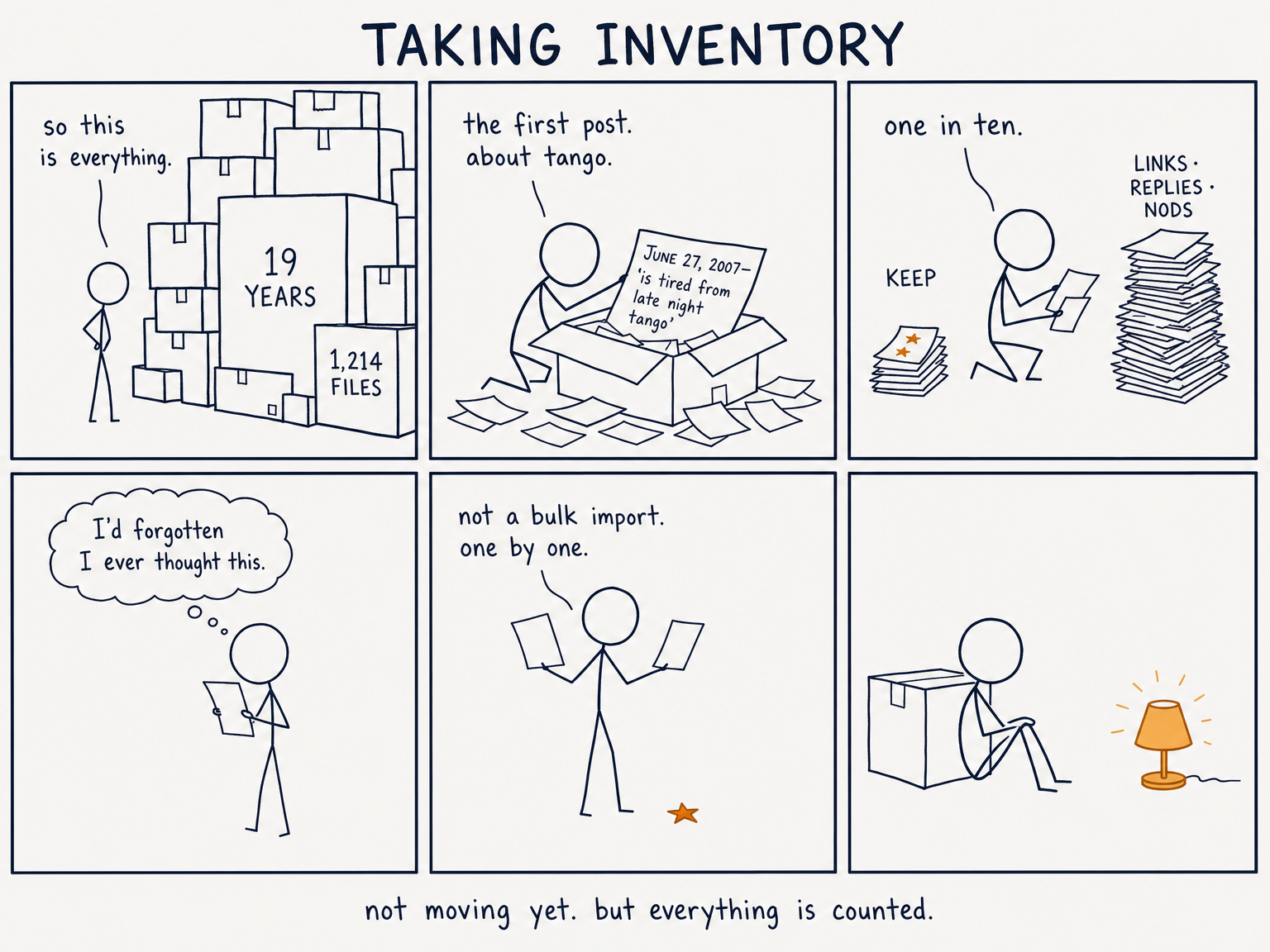
The first entry is dated June 27, 2007: “is tired from late night tango.” The first thing I ever posted on Facebook, and it’s about tango — the archive opens on exactly the right note. My Facebook anniversary is every June 27. I never kept track; the export did, and Facebook, of course, as well.
The good news: everything (really?) is in there, in JSON. The text of every post, every comment, with timestamps going back to 2007.
Facebook also offers the export as HTML — your past rendered as pages you can click through, but nothing a script can process. That’s a way of looking at it, not a way of keeping it; my pipeline runs on the JSON.
The bad news starts immediately. The rent I already mentioned; on top of it, the export comes with three taxes:
- The mojibake tax — on characters. Your umlauts, mangled for a decade and a half.
- The mention tax — on names. Your people, reduced to internal IDs.
- The context tax — the big one, on structure. The words survive; the web around them doesn’t.
Each gets its section below — collapsed, so you can skip the plumbing. I’ve kept the counts out of the prose on purpose: they all live in the figures of this series — in part two, the data story, and in the appendix.
The mojibake tax — a tax on characters
Open the export and your German looks like this: “Tanzen im Rhein-Neckar-Delta… Heidelberg, Mannheim” becomes “⦔, “ä” becomes “ä”. Facebook’s export pipeline decoded UTF-8 bytes as Latin-1 somewhere, years ago, and nobody ever fixed it.
The fix is one line per string — encode back to Latin-1, decode as UTF-8 — but you have to know that’s the disease before you can apply the cure. If you skip it, every umlaut in nineteen years of writing is garbage — your whole past, misspelled.
The mention tax — a tax on names
Facebook posts reference people as @[100064746486254:2048:Rhein-Neckar-Tango] — internal IDs with display names bolted on. A regex turns them back into plain names. Your mentions, however, point at Facebook’s database, not yours — the ID tells you nothing once you leave.
The context tax — a tax on things that belong together but don't get saved together
Comments carry no IDs. Not the comment’s ID, not the parent post’s ID, nothing. The file says “Daniel de Kay commented on a post.” — and stops. If you want the context of a comment you wrote back then, the export has a text for you and a dead end next to it. Facebook search won’t find your comments anymore either, so the official channels are closed.
What saved part of it, for me: three side channels.
- The reactions files — plural, and that’s already the story: one main file, plus shards, going back years. When I reacted to my own post, the main file recorded the post’s permalink — which reconstructed deep links to a slice of my posts.
- The edits file — a list of everything I edited, each entry with an internal fbid. Text-matching those against the archive recovered more posts and comments.
- The media folder — photo files are literally named by their fbid, which gives you a working photo.php deep link.
Altogether, a healthy slice of my long posts now has a working link back to the original context. The rest — group content has no group IDs, comments mostly have no parents. The export keeps the words and burns the context. That’s the design: it records what you did, never where you did it.
Sorting the wheat from the chaff
Most of the timeline is link shares — “shared a link”, over and over. The writing I actually cared about lives elsewhere: posts that carry text at all, a smaller pile of those longer than a paragraph, and within it the essays, the arguments, the things worth keeping.
Nineteen years of posting, and the bulk of it is sharing links, reacting, nodding along. The archive preserved a conversation, not a publication --- and I’m still deciding how I feel about that.
In the end I extracted a shelf of clean markdown files — long posts, long comments, group posts, group comments — each one with an ISO date in the frontmatter, sorted by year, with an index per kind. The peaks tell their own story: the pandemic year, when the tango world debated whether to survive; the community essays; the tango culture pieces I’d forgotten writing.
An uncomfortable footnote: none of this is illegal. I asked under GDPR Article 15, and what came back is compliant — all of my personal data, in a machine-readable format, on time. But a compliant export you cannot put anywhere else is paperwork. Compliance is not interoperability.
What comes next
The series in brief: part two is the data story — nineteen years of posting plotted since 2007, when I posted, what about, when it peaked, when it stopped. Part three enters the dark room: everything the export doesn’t contain — past what the rescue channels of this part can reach — and why even Facebook itself can’t give it back. Part four reads the corpus as a voice archive — the style, German and English, the topics that held. Part five is about the few that come home — the handful I don’t want to miss, a case-by-case decision, not a bulk import; the archive itself stays private. And it comes with the how-to, too: how to run the same job on your own export, and why I ordered it twice.
Nineteen years of my writing sit in a building I don’t own, on terms the landlord revises whenever the business demands. The German proverb has it right: your own hearth is worth gold.
One practical note if you want to do your own export: request it with media, expect a ZIP of several gigabytes, and expect the JSON to be one long line per file — your tools will need to handle that. And do it before you need it. The export takes days, and Facebook has form for making features disappear overnight.
Time to move some furniture of my own.
Next in the series: nineteen years of posting, plotted since 2007 — the data story.